

4 High-Converting Supplement Quiz Funnel Examples







Trusted by 3,000+ marketers





What if your supplement online shop could act like a personal nutritionist, guiding every visitor to the exact supplement they need? That's precisely what supplement quiz funnels do. Many leading supplement brands use quiz funnels to cut through decision fatigue, build trust, and turn passive browsers into buyers. Let's break down four real-world supplement quiz funnel examples you can learn from today.
Key Takeaways
Supplement quiz funnels reduce choice overload and guide decisions: Shoppers don't want more options; they want the right option. And in a category like supplements, where skepticism is high and purchase intent starts low, a quiz funnel turns product discovery into a purchase.
Trust is built before the first purchase: The best-performing supplement quiz funnels build value through education and social proof before revealing price or asking for payment.
Personalization outperforms generic funnels. Supplement quiz funnels that adapt questions based on user answers often outperform static landing pages in conversion rate tests.
Heyflow is the right funnel builder for supplement brands: With advanced conditional logic, native TikTok and Meta CAPI, in-funnel Stripe payments, phone validation, and SMS OTP, Heyflow lets supplement brands launch quiz funnels that really convert, all without developers.
4 Real-World Examples of Quiz Funnels for Supplements
Not every supplement brand builds its quiz funnel the same way. Some sell a single product and use the quiz purely for education. Others manage dozens of SKUs and rely on the quiz to route visitors to the right match. Yet the highest-converting quiz funnel examples all share three principles: they reduce choice overload, build trust mid-funnel through social proof and education, and deliver personalized recommendations that feel tailor-made rather than templated.
The brands below range from telehealth-adjacent men's wellness to all-in-one greens and complete meal replacements. After each breakdown, you'll find the specific tactics that make it work so you can apply them to your own funnel.
1. Mars Men
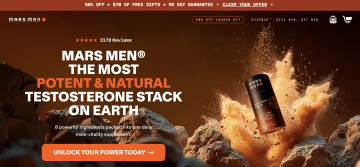
Someone scrolling through Instagram at 10pm who clicks on a testosterone ad is not ready to buy: they're curious at best, skeptical at worst. Mars Men, a natural testosterone supplement brand, uses a quiz funnel to bridge that gap: turning a cold audience into a buyer by making them feel understood before they even see a product page.
What makes it effective:
Audience-matched visual design: The funnel's bold, masculine visual design and direct language immediately signal who this brand is for, creating an emotional connection before the first question is even answered.
Personalization at every step: The funnel opens by asking the user about their biggest masculine health concern - energy, muscle mass, or mental focus. That answer sets the tone for everything that follows. Questions about stress symptoms, afternoon energy crashes, sleep quality, and body composition don't just collect data; they make the user feel like the funnel is paying attention. The outcome page then reflects all of it back: a testosterone decline score, identified root causes, and a projected improvement timeline with a specific target date.
Trust signals throughout: Advisor-style framing, "why we ask" explanations on sensitive questions, social proof screens, and clinical-sounding result summaries all work together to build credibility before the product is ever introduced.
Value stacking at checkout: The cart screen combines a 50% lifetime discount, free shipping, two bonus gifts, and a 90-day money-back guarantee in a single view. Every element is designed to eliminate the last remaining objection before the user completes the purchase.

Heyflow's calculations feature and conditional logic make it straightforward to replicate this kind of lead-scoring and personalized outcome experience without any developer involvement.
2. Forge Men
Most men over 40 who click on a skincare or supplement ad don't think of themselves as wellness buyers. They think of themselves as men who are starting to look older and feel less sharp than they used to. Forge Men, a men's health brand offering both skincare and supplements, uses a quiz funnel to meet that audience exactly where they are, turning a vague awareness of aging into a personalized skin profile and a concrete reason to buy.

What makes it effective:
Visual questions to drive emotional recognition: Rather than asking about skin concerns just in text form, the funnel uses close-up photo tiles of real aging skin (wrinkles, eye bags, saggy skin, dark spots). The question "When I look in the mirror, I see..." forces a moment of self-recognition that abstract answer options never could.
Education as a non-question screen: A "Did You Know?" screen mid-funnel introduces the brand's core ingredient claim with a before/after visual. This screen doesn't ask anything, it simply plants a reason to believe before the product recommendation arrives.
Quiz-driven offer with embedded checkout: The product page reflects the user's quiz results directly. The recommended supply length is tied to their skin profile, the pricing is framed as an exclusive quiz discount, and a live purchase counter adds urgency. Rather than redirecting to a separate checkout page, the purchase is completed within the same flow, reducing drop-off at the most critical moment in the funnel.
Expert authority on the product page: A dermatologist endorsement with credentials and awards closes the trust gap for a category where skepticism runs high. By the time the user reaches the add-to-cart button, the product has been validated by a named expert, peer reviews, and the user's own quiz results.

3. Huel
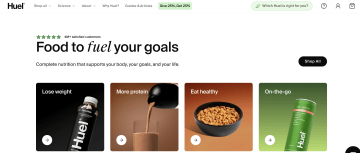
Huel is a complete nutrition brand offering meals, protein powders, and supplements. Their quiz funnel solves a problem many ecommerce brands face: routing website visitors through a large, diverse product catalog without overwhelming them. The quiz uses a conversational AI-powered product finder that lets users describe their goals in natural language, turning product discovery into a conversion.
What makes it work:
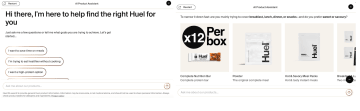
Conversational AI format that removes friction: Rather than presenting a series of multiple-choice screens, the funnel opens with a simple text prompt, where users describe what they're looking for in their own words. This lowers the barrier to engage significantly, because typing a goal feels natural in a way that clicking through predefined options often doesn't. The experience feels closer to messaging a knowledgeable friend than filling out a form.
Persistent navigation placement that captures passive browsers: The product finder isn't buried on a landing page, it lives in the main navigation, making it accessible at any point during a visit.
Immediate, specific recommendations that close the gap between interest and purchase: After a single input, the funnel returns concrete product suggestions with relevant details, not a generic category page. The user goes from describing a vague goal to seeing an exact product match in seconds, which dramatically shortens the consideration phase and reduces the likelihood of drop-off.
4. Hims
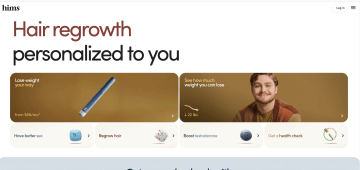
Most people who click on a mental health ad aren't ready to talk to a doctor. They're not even sure they have a problem worth addressing. Hims, a men's telehealth and supplements brand, uses a quiz funnel to bridge that gap, turning an uncomfortable, stigma-loaded topic into a structured, clinical-feeling self-assessment that makes seeking help feel like the logical next step.
What makes it work:
Clinically framed questions that normalize the experience: The assessment uses standardized mental health screening language. This clinical framing does two things simultaneously: it makes the user feel like they're taking a real assessment, and it removes the emotional friction of having to self-diagnose in their own words.
Personalized score as the outcome: At the end of the assessment, the user receives a score that reflects the severity of what they've been experiencing. The result reframes the entire quiz as a diagnostic tool, not a sales funnel, which is precisely what makes the product recommendation that follows feel credible and necessary.
Disqualification as a trust signal: Not every user is matched with a treatment. The funnel explicitly tells some users that they may not be the right fit. This is a rare move in direct-to-consumer marketing that dramatically increases the perceived legitimacy of the assessment and the credibility of the brand overall.
The key tactic? Hims treats the quiz as a consultation, not a shopping experience. This reframes the purchase as a health decision rather than an impulse buy, which dramatically increases both completion rates and conversions.
The Best Funnel Builder for Supplement Quiz Funnels
The quiz funnels above have one thing in common: they turn a cold, low-intent audience into a buyer by making every step of the experience feel personal and relevant. But building quiz funnels with personalized outcome pages, lead scoring, server-side tracking, and embedded checkout typically requires multiple tools stitched together. Heyflow changes that by combining all the marketing relevant features in a single platform.
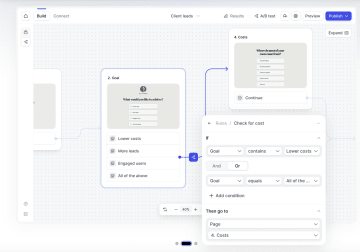
✅ Advanced conditional logic. Build complex branching paths based on multiple answers about goals, health concerns, lifestyle, or body type, and visualize every logic branch with the built-in Visual Logic Map.
✅ Pixel-perfect brand replication without CSS. 2,000+ design variables match any brand aesthetic — bold masculine, clinical, lifestyle — entirely through the UI
✅ Native server-side Conversions API for Meta, TikTok, Microsoft/Bing Ads, Taboola, and Outbrain. Google Ads and LinkedIn run via client-side tracking. All platforms are fully integrated within Heyflow, without Zapier, GTM, or custom code needed.
✅ Partial submit tracking. Heyflow captures the data users have already entered, even if they drop off before the final screen, and passes it directly to your CRM or email automation tool. For supplement funnels with longer quiz flows, this turns incomplete sessions into remarketing opportunities. A user who drops off after question five has already revealed health intent data - goal, symptoms, lifestyle - that can be passed directly back to Meta or TikTok via CAPI for precise retargeting.
✅ Seamless payment integration. Stripe and Solidgate checkout run directly inside the funnel, preserving the trust and personalization built throughout the quiz. Apple Pay and Google Pay are supported out of the box, so mobile users can complete their purchase with a single tap.
✅ Instant lead engagement without Zapier. New leads trigger native WhatsApp messages, branded email autoresponders via custom SMTP, and Slack notifications automatically without additional automation tools.
✅ Native A/B testing + AI Insights. Test question orders, answer formats, outcome page headlines, and CTA copy without external tools. Every iteration compounds over time into significantly higher conversion rates. AI Insights delivers screen-by-screen suggestions to boost conversion rate, and AI Flow Analysis identifies performance bottlenecks across the entire funnel automatically.
✅ Mobile-first performance with a 90+ page speed score. Supplement brands run almost exclusively on Meta and native ad traffic, which means nearly every user arrives on mobile. Every Heyflow funnel loads lightning-fast on any device and any connection, because slow load times are silent conversion killers for cold audiences.
✅ Built-in lead quality. Carrier-level phone validation, SMS OTP verification, and email validation ensure every lead is real before it hits your CRM.
✅ HIPAA-compliant on every plan. Unlike most funnel builders, which lock HIPAA behind an Enterprise plan, Heyflow offers HIPAA compliance on all paid plans, so supplement and telehealth brands are covered from the very first lead.
✅ Sensitive Tag for automatic PII deletion. For health funnels that collect symptom data, body metrics, or lifestyle information, Heyflow's Sensitive Tag automatically deletes personally identifiable information from Heyflow's servers after it has been passed to your CRM or integration. No other funnel builder offers this natively, making it a critical data minimization layer for supplement and telehealth brands.
✅ Native Taboola and Outbrain server-side tracking. Supplement brands running native advertising campaigns can connect Taboola and Outbrain natively via server-side tracking; no third-party tools are required.
✅ TrustedForm and Jornaya integration. For supplement brands scaling on Meta and TikTok, TCPA compliance and consent certification are increasingly critical. Heyflow integrates natively with both TrustedForm and Jornaya
Conclusion: The Conversion Power of Quiz Funnels for Supplements
The pattern across all four brands is clear: supplement quiz funnels work because they transform passive browsing into an active, personalized conversation. Instead of dumping visitors onto static landing pages packed with options, these brands guide users toward the right product through relevant questions, social proof, and education.
With Heyflow, you can create quiz funnels that really convert without writing a single line of code. Native server-side CAPI for Meta and TikTok, built-in phone validation and OTP, Stripe and Solidgate payment integration, and a visual conditional logic builder give your team everything needed to launch, optimize, and scale a supplement funnel independently.
Build your high-converting supplement quiz funnel with HeyflowFAQ
How many questions should I include in my supplement quiz funnel?
There's no universal number. Length isn't the enemy, friction is. Successful supplement quizzes range from 5 to 20+ questions. The key is that every screen earns its place by collecting data that visibly improves the recommendation. Use conditional logic to skip irrelevant questions automatically.
What questions work best in a supplement quiz funnel?
Start with the user's primary health goal (energy, sleep, muscle, weight), then layer in lifestyle factors like diet, exercise frequency, and stress level. Avoid medical-sounding questions too early. The best-performing quizzes open with emotionally engaging, easy-to-answer questions before progressing to more specific or personal ones.
What conversion rate can I expect from a supplement quiz funnel?
Most supplement brands see their conversion rate at least double when switching from a static landing page to a personalized quiz funnel. The biggest gains come from combining personalized outcome pages with native A/B testing, which lets you continuously optimize question order, CTA copy, and offer framing directly within Heyflow. Brands using Heyflow have reported conversion rate increases of 80 percent or more.
When should I ask for contact details in a supplement quiz funnel?
After you've delivered value, not before. The most effective supplement funnels ask for email or phone only after users have invested time answering questions and feel curious about their personalized results. Asking too early, before building perceived value, significantly increases drop-off rates.
Which funnel builder offers native CAPI for supplement brands?
Heyflow is the only funnel builder with native server-side Conversions API support for Meta and TikTok, configured directly within the platform without any third-party tools. For supplement brands, this matters because iOS privacy changes and ad blockers increasingly block client-side pixels, meaning campaigns running on pixel-only tracking are optimizing on incomplete data. Heyflow also supports native server-side tracking for Microsoft Bing Ads, Taboola, and Outbrain, making it the only funnel builder purpose-built for the full channel mix supplement brands actually use.
Can I build a supplement quiz funnel without coding?
Yes. No-code funnel builders like Heyflow let you create fully branded, multi-step quiz funnels with conditional logic, in-funnel payments, and CRM integrations through drag-and-drop. You can launch a complete supplement quiz funnel without any developer involvement.
How do I track conversions from my supplement quiz funnel?
The most reliable approach is server-side tracking via a Conversions API. Heyflow connects natively to Meta and TikTok CAPI, as well as Microsoft/Bing Ads, without requiring Zapier, GTM, or custom code. This ensures every quiz completion and purchase event is tracked accurately, even in a cookieless environment.
How much does it cost to build a supplement quiz funnel?
The cost depends on how you build it. A fully custom-developed funnel built by an agency can run anywhere from €5,000 to €25,000 or more before a single lead is captured. The most cost-efficient starting point is a no-code funnel builder like Heyflow, where plans start at €49 per month and a single marketer can launch a fully branded quiz funnel with conditional logic, personalized outcome pages, in-funnel payments, and server-side tracking in a matter of days. A 14-day free trial lets you build and validate the full funnel before committing to a paid plan.
Recommended articles
The 5 Best AI Landing Page Builders 2026: Ranked by Use Case & Conversion Potential
Every AI tool can generate a page now. We compare the 5 best AI landing page builders on tracking, lead validation, testing, and compliance.
Read more
The 6 Best Lovable Alternatives for High-ROAS Funnels (2026)
Lovable is great for building apps, but not for funnels. Compare 6 Lovable alternatives, including Heyflow, built for high-ROAS forms and sign-ups.
Read more
Conversion Rate Optimization Tools: The 8 Best Platforms 2026
Most CRO lists compare tools built for different jobs. See which of 8 conversion rate optimization tools fits a paid-traffic funnel. Compare now.
Read more