

B2B Lead Generation: A Complete Guide to Strategies, Tools & Best Practices (2026)







Trusted by 3,000+ marketers






Most B2B companies generate plenty of leads – just not the right ones. Spray-and-pray tactics fill pipelines with noise, not revenue. Effective B2B lead generation means reaching decision-makers who actually need what you sell, before your competitors do. With AI-driven qualification and signal-based targeting reshaping how pipelines get built in 2026, the playbook has changed. Here's everything you need to build a system that delivers.
Key Takeaways
Quality beats volume. The winning B2B lead gen programs in 2026 focus on ICP fit and buying intent, not list size.
Protect attribution with server-side tracking. As third-party cookies decline, native server-side conversion signals (Meta Conversions API, TikTok Events API) are how you keep your ad platforms optimizing on real pipeline.
Validate leads at the point of capture. Phone and SMS OTP verification, partial submits, and TrustedForm/Jornaya protect your sales team from bad leads and inflated CPL.
Heyflow brings all of this together. Interactive funnels, phone + SMS OTP validation, native server-side tracking for Meta and TikTok, drop-off analytics per screen, and AI flow generation, in one no-code platform built for performance marketers.
Why is B2B lead generation important for your business?
Without a steady flow of quality leads, keeping momentum becomes a challenge. Here's why B2B lead generation is important:
Brings in sales and revenue: You're connecting with people who actually need your product or service. These high-quality leads are far more likely to convert, which means you're likely to see more sales leads become paying customers.
Keeps your sales pipeline full: A well-maintained sales pipeline means your sales team can focus on real conversations with warm leads instead of wasting hours on cold calls. Creating lead magnets that pull in the right audience is a big part of this.
Boosts your return on investment (ROI): High-quality leads mean better ROI. Your team is focused on people who are ready to convert, so every marketing dollar works harder and goes farther.
Powers long-term growth: With a strong pipeline, you're not just growing for today – you're setting up your business for long-term success. Whether you're eyeing new markets or scaling your client base, B2B lead gen helps you build momentum that keeps giving.
Simplify your B2B lead generation process. Heyflow makes it easy to design no-code custom lead forms and landing pages with a simple drag-and-drop builder. Effortlessly capture more B2B leads and boost your conversions.
Try Heyflow for freeTypes of B2B leads
Different lead types signal different distances to purchase. Here they are, ordered from least to most ready-to-buy, so you know where and how to focus your efforts.
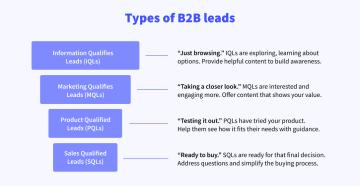
Information Qualified Leads (IQLs) are at the top of the B2B sales funnel
— the „just browsing" crowd. These leads are just starting their buying journey. They've given you basic info, like an email address, in exchange for content like a report, guide, or educational material that answers their questions, but they're far from ready to buy. IQLs are researching solutions, comparing options, and getting a feel for what's out there. They might not know much about your business yet, but they're open to learning. While IQLs aren't ready to make decisions, they're a prime opportunity for lead nurturing.
Marketing Qualified Leads (MQLs) are a step further down the funnel — they've shown an interest in your marketing campaigns, engaged with your content more than once, and are showing signs of potential. They're familiar with your brand and might even see it as a possible solution, but they're still evaluating options.
Product Qualified Leads (PQLs) are the ones who've gone beyond just reading about your solution — they've tried it. These leads have engaged directly with your product through a free trial, demo, or freemium version and have experienced firsthand how it could work for their business. At this point, they're weighing the benefits and asking, „Is this what we need?". Your approach here should be hands-on. Offer support, highlight key features, and answer questions that help them get the most out of their trial. The goal? Turn their interest into commitment, and show them why your product is worth the investment.
Sales Qualified Leads (SQLs) are as close as you get to the finish line. SQLs have shown strong buying intent, like requesting a demo, asking detailed questions, or directly reaching out to your sales team. They're no longer wondering if they need your solution; they're figuring out when and how. With SQLs, it's time to focus on closing. They need to know why choosing you is the best move. Your goal here? Answer specific questions, address any last-minute concerns, and give them the confidence to say, „Let's do this."
Inbound vs. outbound B2B lead generation
B2B lead generation falls into two broad approaches, and the strongest strategies combine both:
Inbound lead generation attracts prospects to you through content, SEO, webinars, and social media. Leads come in because they found value in what you published. These tend to be warmer and more self-qualified.
Outbound lead generation means reaching out proactively — through cold email, LinkedIn prospecting, paid ads, or phone calls. You're initiating contact rather than waiting to be found. Outbound is faster to scale but requires more precise targeting to avoid wasted effort.
In practice, inbound builds long-term pipeline momentum while outbound fills gaps quickly. The best B2B teams don't choose between them: they use inbound signals to inform outbound outreach, creating a flywheel that gets more efficient over time.
B2B lead generation strategies
Let's look at proven lead generation techniques that attract the right people and guide them smoothly through the funnel. These aren't generic tips – each one is a distinct channel or tactic worth investing in.
1. Develop valuable content
Create content that addresses real problems your audience faces. Offer solutions, insights, and resources they'll find useful. The goal is to make potential buyers think, "These people really get what I'm dealing with." Blog posts, white papers, original research, and comparison guides all work – but only if they go deeper than what's already freely available.
2. Attract with SEO
When leads search for answers, make sure they'll find you at the top of the results. Use keywords that align with what your ICP is searching for – not just broad terms, but specific queries that signal buying intent. A buyer searching "best CRM for construction companies" is much closer to a purchase than one searching "what is a CRM."
3. Leverage LinkedIn for B2B lead generation
LinkedIn generates the majority of B2B leads from social media, making it the single most important social platform for B2B marketers. There are two complementary approaches: organic and paid.
On the organic side, consistent thought leadership content – sharing insights, commentary on industry trends, and practical advice – builds authority with your target audience over time. On the paid side, LinkedIn Lead Gen Forms, Sponsored InMail, and Conversation Ads allow precise targeting by job title, company size, industry, and seniority. For high-value accounts, LinkedIn is often the most direct route to decision-makers.
4. Run targeted cold email outreach
Cold email remains one of the most cost-effective outbound tactics when done right. The key is personalization at scale: reference something specific about the prospect's company or role, lead with a relevant insight or problem, and make the ask small (a 15-minute call, not a full demo). Tools like Apollo.io, Lemlist, and Outreach.io allow you to build sequences, personalize at scale, and track engagement. Keep lists tight and well-researched – volume without targeting just burns your sender reputation.
5. Nurture with email (not spam)
Email is a great way to keep in touch without being pushy. Segment your list and send content that fits where each lead is in their journey. For those just browsing, share a case study; for the ready-to-buy, offer a consultation. Your goal is to stay relevant, not relentless. Automated drip sequences triggered by specific behaviors – downloading a resource, visiting your pricing page – outperform generic broadcast emails every time.
6. Reach them with pay-per-click (PPC) ads
Google Ads, LinkedIn Ads, Meta Ads, and TikTok Ads can reach your target audience at the right moment – when they're actively searching for a solution or when they match your ICP criteria. When you target specific pain points and pair ads with high-converting landing pages or interactive funnels (rather than generic homepages), your cost per lead drops significantly. PPC is your fast-track to pipeline, but only when the post-click experience matches the promise in the ad – and when the conversion signal gets back to the ad platform. Modern paid B2B relies on server-side conversion tracking (Meta Conversions API, TikTok Events API) to protect attribution as third-party cookies disappear.
Platforms like Heyflow send those signals natively, so your bid optimization sees every qualified lead, not just the ones that survive browser restrictions.
7. Use lead magnets that answer real questions
Offer downloadable resources like checklists, templates, ROI calculators, or industry benchmarks in exchange for contact details. Make it something they can't resist because it's practical and solves a problem right away. Leads get valuable content, and you get qualified contacts to nurture. The best B2B lead magnets are specific – "The 2026 SaaS Pricing Benchmark Report" will outperform "A Guide to SaaS" every time.
8. Host webinars to educate and connect
Webinars are ideal for showcasing your expertise and collecting highly qualified leads. Choose topics that solve real issues for your ICP and let prospects get a feel for what you bring to the table. You're not just teaching – you're building trust with people who want answers. Follow-up sequences after the webinar, segmented by whether attendees stayed for the full session, can dramatically improve conversion rates.
9. Get specific with account-based marketing (ABM)
ABM is all about giving high-value target accounts a personalized experience. Instead of a broad approach, you focus on a defined list of companies – often your top 50 or 100 ideal prospects – and tailor messaging, ads, content, and outreach specifically to their situation. When it feels tailored, it feels relevant. ABM typically delivers higher deal values and shorter sales cycles, but requires tight alignment between marketing and sales.
10. Make happy clients your advocates
Your existing customers can bring in quality leads through referral programs. Offer perks for bringing in new prospects – a discount, exclusive access, or a simple thank-you – so they're motivated to spread the word to peers who trust them. In B2B, a warm referral from a peer carries more weight than almost any other lead source.
11. Network and build partnerships
Partnering with complementary businesses or industry influencers expands your reach without a lot of extra effort. For example, if you're a CRM company, team up with a digital agency – they get leads, you get leads, and everyone wins. Co-authored content, joint webinars, and partner newsletters are all low-effort ways to tap into an adjacent audience that already trusts your partner.
12. Use case studies and social proof
B2B buyers are risk-averse. A detailed case study showing how a company similar to theirs achieved measurable results is often the final nudge that converts a warm lead into a sales conversation. Feature specific metrics (not vague claims), quote real customers, and make case studies easy to find. Testimonials, G2 reviews, and third-party ratings serve a similar function – they reduce perceived risk at the moment of decision.
These strategies lay the groundwork for successful B2B lead generation, but knowing the how is just as important as the what.
How to generate B2B leads in 6 steps
It's time to get practical. Here's your step-by-step guide to launching lead generation campaigns that actually work.
1. Identify your target audience and ideal customer profile (ICP)
Every effective lead generation campaign starts with a deep understanding of who you're trying to reach.
First, define your target customer – the types of companies and decision-makers who stand to gain the most from your solution.
Then, get specific by creating an ideal customer profile (ICP). Your ICP is a detailed profile of your best-fit customer – the kind of client who benefits from your product and is most likely to buy it.
When you create your ICP, ask questions like: What industry are they in? How big is their company? What's their budget? Who are the key decision-makers – are we talking CFOs, IT directors, or the CEO who's tired of outdated tools? The more detailed, the sharper your focus.
For example, if you're selling project management software for construction operations, your ICP might be mid-sized construction firms with 50–200 employees, $5M–$50M in revenue, and a project manager who's desperate to ditch spreadsheets. With an ICP like this, you're going straight to leads who are primed to see your value.
2. Choose a B2B lead generation tool
Think of it like this: your ICP is the who, and your lead gen tool is the how. The right tool can automate and scale your efforts, making it easier to find, connect with, and nurture those high-quality leads.
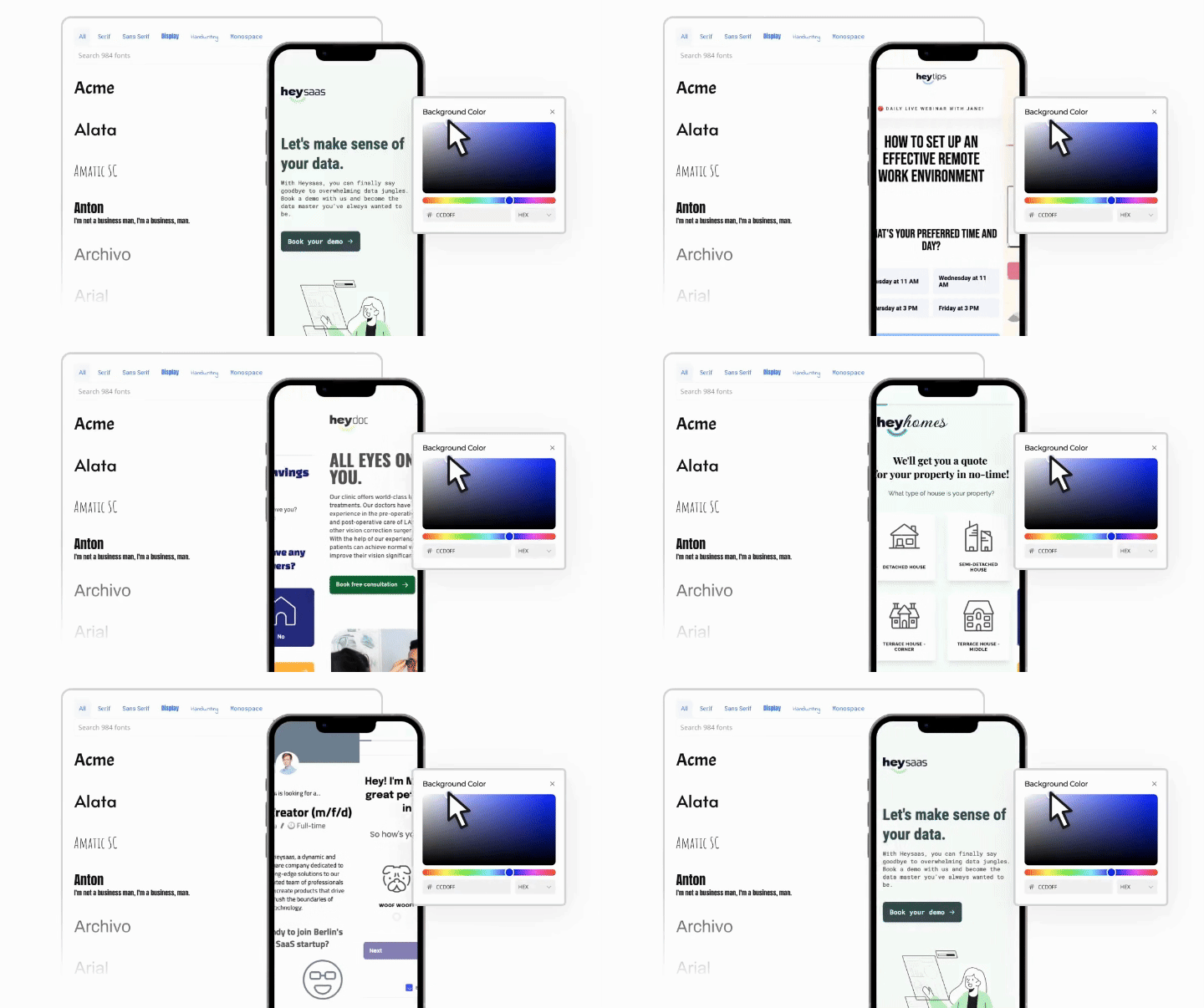
For example, with a no-code platform like Heyflow, you can create interactive lead forms, funnels, and landing pages. Heyflow offers a drag-and-drop interface with over 40 building blocks and more than 2,000 design variables that can be customized to be 100% on-brand. Unlike static forms, multi-step Heyflow funnels guide each visitor through a personalized path using conditional logic, validate leads at the point of capture with phone and SMS OTP verification, and send server-side conversion signals straight to Meta and TikTok – so every lead you collect is higher quality and fully attributable.
3. Create a powerful lead magnet
A lead magnet is a high-value freebie that speaks directly to your ideal customer's biggest needs. It's your "I know exactly what you're dealing with" moment – a resource so spot-on they'll sign up for it without a second thought.
Maybe it's a "Streamline Your Supply Chain" guide for manufacturing pros or a "5 Cost-Cutting Moves for Factory Managers" checklist. Whatever it is, it should be something they can put to use right now and think, "Wow, these folks really know their stuff."
Remember: a good B2B lead magnet hints at what more your potential customers will get in exchange for their contact data. Create something practical, punchy, and perfectly aligned with the value you bring, and you'll have a list of leads who can't wait to see what's next.
4. Design high-converting landing pages and CTAs
Once you've got your lead magnet ready, it needs a home – a landing page that makes it easy (and irresistible) for visitors to sign up. Highlight the benefit right away, and use bullet points to break down what they'll get and why it matters.
If you're unsure of how to get started, use templates to give you a head start. For example, Heyflow offers templates designed specifically for goals like lead generation and registrations, so you can pick one that's already optimized for conversions.
With Heyflow's design flexibility, you can easily customize every detail – adjust colors and fonts, add emojis, and choose from thousands of icons. You want to create a landing page that feels uniquely yours without hours of design work. And because all Heyflow funnels are mobile-first by default with page speed scores above 90, you're not losing leads to slow load times on mobile – where the majority of B2B traffic now arrives.
5. Nurture and qualify leads with automation
Once those leads start coming in, your next step is to keep them engaged and identify the ones most likely to convert. Automated emails, follow-ups, and lead-scoring tools can help you stay top-of-mind when they're ready to buy.
For example, let's say a lead downloads your guide, instantly gets a welcome email, then receives a sequence of emails over the next few days with more tips that nudge them closer to a decision. Meanwhile, automation is tracking every interaction – each click, open, or download – so you know who's really interested and who's just window-shopping.

Heyflow's 50+ native integrations make it easy to connect directly with HubSpot, Salesforce, Pipedrive, ActiveCampaign, Calendly, and WhatsApp – no middleware required. That means a qualified lead can go straight from funnel submission to CRM record to a booked meeting – without ever leaving the Heyflow experience, and without your sales team waiting hours for a handoff. You can also send conversions back to your ad platforms with native server-side tracking for Meta (Conversions API) and TikTok (Events API) – no Zapier, GTM, or Stape required – plus client-side tracking for Google Ads and LinkedIn, so attribution stays intact across every major B2B ad channel. And for thousands of additional tools, Zapier or Make has you covered. By the time a lead hits the right score, they're warmed up and ready, saving you time and getting you closer to the sale.
6. Track performance and optimize the campaign
Once your lead generation campaign is up and running, you need to know what's working, what isn't, and where you can level up.
Here are the key B2B lead generation KPIs to track:
KPI | What it measures | Why it matters |
Conversion rate | % of visitors who complete your form or funnel | Reveals how well your landing page and offer are working |
Cost per lead (CPL) | Total spend ÷ number of leads generated | Core efficiency metric for paid campaigns |
Lead-to-MQL rate | % of raw leads that meet marketing qualification criteria | Indicates targeting quality – low rates mean poor-fit traffic |
MQL-to-SQL rate | % of MQLs accepted by sales as sales-ready | Measures alignment between marketing and sales |
Click-through rate (CTR) | % of people clicking your CTAs in ads or emails | A low CTR signals your offer or messaging needs work |
Lead quality score | Engagement level: opens, downloads, clicks | Identifies your most engaged – and most likely to convert – leads |
Traffic source breakdown | Which channels drive the most and best leads | Helps you double down on what works and cut what doesn't |
Customer acquisition cost (CAC) | Total sales + marketing spend ÷ new customers | The ultimate measure of lead gen efficiency |
Heyflow's built-in analytics makes this easy by providing a real-time look at how your lead funnels, forms, and landing pages are performing. You can see what's getting clicks and engagement, run A/B tests to compare versions, and get insights into how to refine your campaigns.
Best practices for B2B lead generation
Applying B2B lead generation best practices is about fine-tuning your approach for maximum results. Here are the tactics that consistently separate high-performing programs from average ones:
Use interactive funnels instead of static forms: Multi-step, conversational funnels consistently outperform single-page static forms. The experience feels personal rather than administrative, and prospects who engage with a well-designed funnel are more likely to complete it and more likely to convert downstream.
Validate leads at the point of capture: Poor-quality leads waste your sales team's time and inflate your CPL. Features like phone number validation and SMS OTP verification (built into Heyflow) ensure that the contact details you collect are real – dramatically improving lead quality before anyone picks up the phone.
Get chatty with conversational marketing: Use live chats or AI-powered chatbots to answer questions, qualify leads, and show off your brand's personality – all in real time. Conversational interfaces reduce friction and can qualify or route leads faster than any form.
Create personalized content paths: Let visitors pick their own journey based on their industry or role, leading them to content that actually speaks to their situation. Conditional logic in your funnels makes this possible without any developer involvement.
Invest in video content: Video consistently outperforms text-only content for B2B engagement. Whether it's a product walkthrough, a customer story, or a thought leadership piece, video builds trust and communicates complex value propositions faster than written content alone.
Host VIP-only roundtables or webinars: Make it exclusive. Invite high-value leads to a private roundtable or a small-group webinar where they can get insider insights and connect with peers. A personal invite to a curated event signals that you understand their world.
Bring them back with retargeting ads: Someone visited your site, engaged with your content, but left without converting? Retargeting ads give them a relevant reminder – especially effective when the ad references the specific content or page they viewed, rather than a generic brand message.
Prioritize first-party data: As third-party cookies continue to disappear, the companies that own rich first-party data – collected directly through their own funnels, forms, and content – will have a significant advantage in targeting, personalization, and measurement. Every lead interaction is an opportunity to enrich your first-party data asset.
How AI is changing B2B lead generation
Artificial intelligence has moved from a buzzword to a practical engine powering the most effective B2B lead generation programs. Understanding where AI adds genuine value – and where it doesn't – is now a core competency for B2B marketers.
AI-powered lead scoring and qualification: Traditional lead scoring assigns points based on simple rules: opened an email (+5), visited pricing page (+10). AI-powered scoring goes further, analyzing hundreds of behavioral and firmographic signals simultaneously to predict which leads are most likely to convert – and when. This means sales teams spend time on the right conversations, not just the most recent ones.
Predictive analytics and intent data: Intent data platforms identify companies that are actively researching topics related to your solution – even before they've visited your website. When a target account suddenly starts consuming content about your category, that's a buying signal worth acting on. Integrating intent data into your outreach means you're reaching out at the moment of highest relevance, not just when it's convenient for your team.
AI for personalization at scale: Generative AI makes it practical to personalize outreach at a scale that was previously impossible. Instead of one cold email template sent to 500 prospects, AI can help craft messages that reference each prospect's specific industry, recent company news, or stated challenges – while maintaining a consistent brand voice. The result: higher reply rates and more qualified conversations.
AI chatbots for real-time qualification: AI-powered chatbots on your website or landing pages can qualify visitors in real time – asking the right questions, routing high-value leads to sales immediately, and nurturing lower-intent visitors with relevant content. Unlike static forms, conversational AI adapts to responses, creating an experience that feels personal rather than transactional.
How Heyflow brings AI into your lead funnel
While AI-powered scoring, intent data, and autonomous agents are reshaping the top of the funnel, Heyflow applies AI directly inside the funnel itself:
AI Flow Generation from Prompt: describe the funnel you want – with tracking, conditional logic, and on-brand styling included – and Heyflow generates a performance-ready version in seconds.
AI Edit on Prompt: refine any existing flow with natural language, from copy tweaks to layout changes, without opening a design tool.
AI Flow Analysis: Heyflow analyzes each flow's performance and returns screen-by-screen CVR suggestions – so optimization takes hours, not sprints.
Build your first AI-generated funnel
Conclusion
B2B lead generation is about creating a process that attracts, engages, and converts the right leads. When you define your ICP, choose the right mix of inbound and outbound strategies, create compelling lead magnets, and build high-converting landing pages, you're setting up a steady flow of quality prospects.
The businesses winning at B2B lead generation in 2026 aren't just spending more: they're building better experiences. Interactive funnels that qualify leads in real time, AI-powered scoring that surfaces the right prospects at the right moment, and first-party data strategies that work regardless of what happens to third-party tracking.
To bring all these strategies together, try Heyflow. With Heyflow's no-code platform, you can design engaging landing pages, create interactive multi-step funnels, validate leads at the point of capture, and connect directly to your CRM and ad platforms, all without writing a line of code. It's B2B lead generation built for how buyers actually behave today.
With Heyflow's no-code platform, you can design interactive funnels and landing pages that turn visitors into qualified leads – without developers, without complexity.
Create interactive B2B lead generation campaigns in minutes!FAQ
How do I improve B2B lead quality without lowering volume?
Add gates at the point of capture rather than after the fact. Phone network validation and SMS OTP verification confirm the contact is real before the lead hits your CRM. TrustedForm and Jornaya add TCPA compliance and consent certification. Combined, these gates cut bad-lead volume at the source without slowing down the pipeline – and they're all native in platforms like Heyflow.
Should I focus on inbound or outbound for B2B lead generation?
Both. Inbound (SEO, content, organic LinkedIn, lead magnets) builds authority and attracts high-intent leads over time. Outbound (cold email, ABM, paid ads) targets named accounts and generates pipeline faster. High-performing B2B programs run them in parallel, with shared messaging and tight marketing/sales alignment.
What are the most effective B2B lead generation strategies?
The most effective B2B lead generation strategies combine inbound and outbound approaches. On the inbound side, SEO-driven content marketing, lead magnets, webinars, and LinkedIn thought leadership consistently deliver qualified pipeline. On the outbound side, targeted email sequences, LinkedIn prospecting, and account-based marketing (ABM) help you reach high-fit accounts proactively. The best results come from using intent signals to prioritize outreach toward prospects who are already in an active buying cycle.
Can AI help me generate more B2B leads?
Yes, but the lift comes from where you apply it. The highest-leverage use cases right now are AI-powered lead scoring, personalization at scale in outbound, and AI inside the funnel itself – building flows from a prompt, refining them in plain language, and analyzing drop-off per screen. Those three together can shorten your optimization cycle from weeks to days.
Recommended articles

How to build successful lead generation campaigns: A complete guide
Master lead generation campaigns with proven strategies and actionable tips to capture leads, boost conversions, and grow your business.
Read more
Step-by-step guide to creating a high-converting lead magnet
Explore the secrets to effective lead magnets. Get relevant tips, best practices, and real examples that convert.
Read more
How Vertigo Media transformed their lead generation with Heyflow
Discover how the agency Vertigo Media enhanced their lead generation by leveraging dynamic landing pages and lead funnels with Heyflow.
Read more