

Connect Your Funnel Builder With Salesforce Using Heyflow







Trusted by 3,000+ marketers






Most teams connecting a funnel builder to Salesforce default to Zapier and assume the job is done. But the integration method you choose directly affects lead response time, data completeness, and whether attribution data survives the transfer at all. This article breaks down the three available approaches, where each one fails under real campaign conditions, and what a production-grade Salesforce integration actually requires.
Key takeaways
Middleware tools like Zapier use polling-based triggers with 1–15 minute delays, making sub-5-minute lead response structurally impossible.
Partial funnel submissions never reach Salesforce with standard form integrations, silently discarding leads who provided qualifying data before dropping off.
Heyflow's native Salesforce integration pushes lead data in real time, maps all funnel fields and UTM parameters, and captures partial submissions without any middleware.
Why the Funnel-to-Salesforce Connection Determines Lead ROI
Getting leads from a funnel into Salesforce sounds straightforward. In practice, the integration method you choose determines how fast leads arrive, how much data survives the transfer, whether attribution data is preserved, and ultimately whether your sales team can act in time to convert. Research across 939 B2B companies found that leads contacted within 5 minutes achieve a 32% close rate — 2.6x higher than those contacted after 24 hours. If your Zapier-based integration introduces a 10-minute polling delay on every submission, you are structurally unable to hit that benchmark.
The integration method also affects what data reaches Salesforce. Standard middleware setups push only the fields you explicitly configure — and only on complete submission. Conditional logic branch data, UTM parameters, partial submit information, and calculated lead scores frequently get lost in transit. For high-CPL verticals like insurance, solar, or financial services, where each lead costs $50–$150 or more, incomplete data in Salesforce means sales teams are flying blind.
Three Ways to Connect a Funnel Builder to Salesforce
Salesforce Web-to-Lead is the platform's built-in form submission mechanism. It requires no external tools, but it has hard limits that make it unsuitable for performance marketing at scale. Salesforce caps Web-to-Lead at 500 requests per 24-hour period — a ceiling that any active paid campaign will hit. It only creates new Lead records (no updates, no deduplication), doesn't support file uploads, and requires JavaScript knowledge for any field validation. It's a starting point for small-volume use cases, not a production integration for performance marketers.
Middleware (Zapier, Make, n8n) is the most common default approach. You connect your funnel builder to Salesforce through an intermediary platform that handles the data transfer. The practical problems are well-documented: Zapier uses polling-based triggers for Salesforce, not real-time webhooks. Depending on your plan, polling intervals range from 1 to 15 minutes. Salesforce is a premium app on Zapier, requiring a paid plan. Rate limit errors, timeout errors, and token revocation issues are common at scale. For agencies managing multiple client Salesforce orgs, maintaining separate Zap configurations becomes a significant operational burden.
Native integration is a direct API connection between the funnel builder and Salesforce, with no middleware dependency. Lead data is pushed in real-time via the Salesforce REST API the moment a submission completes. Field mapping is handled within the funnel builder's interface, and the integration can write to standard Lead objects, Contact/Account objects, or custom objects depending on your Salesforce data model. This is the approach that eliminates latency, reduces failure points, and preserves the full richness of funnel data.
Heyflow's Native Salesforce Integration
Heyflow connects directly to Salesforce without requiring Zapier, Make, or any other middleware. The integration is available on the Advanced Integrations bundle (included in Scale) and on legacy Business plans. Setup takes minutes: authenticate with your Salesforce credentials inside Heyflow's Response Handler tab, select the Leads object, and map your funnel fields to Salesforce properties.
Field mapping in Heyflow covers every input field in your flow, plus built-in metadata: Heyflow ID, Response ID, Referrer, full URL with parameters, and A/B test variant ID and version. You can also map static text values — useful for passing fixed identifiers like campaign names or lead source labels that apply to an entire flow. Every field you want to transfer must have a System Label set; unmapped fields are not transferred.
One important behavior to understand: if a Lead record already exists in Salesforce when a new submission arrives, Heyflow's data will overwrite the existing record. This is the correct behavior for most performance marketing use cases (you want the most recent qualification data), but it's worth configuring Salesforce's Matching Rules and Duplicate Rules to handle deduplication logic on the CRM side.
For teams running paid campaigns, Heyflow's integration and automation capabilities go beyond CRM. Server-side tracking for Meta, TikTok, and Bing runs in parallel with the Salesforce push — meaning each submission simultaneously creates a Salesforce Lead record and fires a conversion event to your ad platforms. This dual data flow is what enables genuine closed-loop attribution without building a custom data pipeline.
Passing UTM Parameters and Ad Click IDs Into Salesforce
Attribution data — UTM parameters, GCLID, FBCLID — needs to reach Salesforce if you want to understand which campaigns generate pipeline. The standard approach is to capture these values in hidden input fields within your funnel, then map those fields to corresponding custom fields in Salesforce through the Response Handler. Heyflow supports this natively: URL parameters are automatically captured and available for mapping alongside any other funnel field.
The practical limitation of UTM-based attribution is well-known: hidden fields typically capture only the last-touch parameters. If a prospect interacted with multiple campaigns before converting, earlier touchpoints are lost. This is a limitation of the approach itself, not of any specific tool. For teams that need multi-touch attribution, the better solution is to combine Heyflow's server-side conversion events with a dedicated attribution layer — but for most performance marketing teams, last-touch UTM data in Salesforce is already a significant improvement over no attribution data at all.
What Happens to Leads That Don't Complete the Funnel
A user who completes three screens of a six-screen funnel — providing name, phone, and qualifying answers before abandoning — represents real intent and real ad spend. Standard form-based integrations only fire on complete submission, so this data never reaches Salesforce. In high-CPL verticals, this represents a meaningful volume of recoverable leads.
Heyflow's partial submit functionality captures data from incomplete funnel sessions and can push that data to your Response Handlers, including Salesforce. This means a prospect who drops off after the qualification screens can still be created as a Lead record in Salesforce, flagged as a partial submission, and routed to a nurture sequence rather than lost entirely. For teams running campaigns where each click costs $20–$100, recovering even a fraction of these partial sessions has a material impact on effective CPL. Learn more about how performance marketers use Heyflow to reduce wasted ad spend.
Lead Quality Before Data Hits Salesforce
The quality of data in Salesforce is only as good as the validation that happens before submission. Heyflow includes phone number validation and SMS-OTP verification natively — meaning you can require prospects to verify their phone number within the funnel before their data is pushed to Salesforce. This eliminates fake numbers, typos, and low-intent submissions from your CRM before they ever arrive.
Conditional logic in Heyflow funnels also enables pre-qualification that translates directly into Salesforce routing. If a prospect answers that their monthly budget is below a threshold, you can branch them to a different outcome — or pass a calculated lead score as a custom Salesforce field that triggers assignment rules automatically. This moves the qualification work from Salesforce (where it requires Einstein Lead Scoring at additional cost) into the funnel itself, where it's free and immediate. For teams building B2C lead generation funnels, this pre-qualification layer is often the difference between a Salesforce instance full of noise and one that sales teams actually trust.
Integration Setup: Connecting Heyflow to Salesforce Step by Step
Step 1: Prepare your funnel fields. Before connecting, ensure every field you want to pass to Salesforce has a System Label assigned in Heyflow's field settings. Fields without System Labels will not be available for mapping.
Step 2: Open the Response Handler. Inside your flow, navigate to the "Connect" tab and select "Response Handlers." Click "Connect to Salesforce." A popup will prompt you for your Salesforce credentials.
Step 3: Authenticate and select the object. Log in with your Salesforce credentials. Once connected, select "Leads" as the target object.
Step 4: Map your fields. For each Salesforce Lead field you want to populate, select the corresponding Heyflow source: a flow input field, a built-in metadata field (Heyflow ID, Response ID, Referrer, URL, A/B test variant), or a static text value. Map all required Salesforce fields — if your Salesforce org has required fields beyond the standard set, the integration will fail until those are mapped.
Step 5: Save and test. Save your configuration, submit a test entry through your funnel, and verify the Lead record appears in Salesforce with the correct field values. If you encounter a connection error, check that the REST API is enabled for your Salesforce organization — this is the most common cause of authentication failures.
If you need to pass UTM parameters, set up hidden input fields in your flow to capture URL parameters before connecting the Response Handler. The UTM parameter tracking guide covers this setup in detail.
Salesforce Integration at Agency Scale
Agencies managing Salesforce integrations across multiple client accounts face a different set of problems than in-house teams. With Zapier, each client requires a separate Zap configuration, a separate Salesforce connection, and separate troubleshooting when something breaks. Zapier's Salesforce connection also has a hard limit of 5 authorized access tokens per Salesforce account — once exceeded, older tokens are revoked without notification, silently breaking integrations.
Heyflow's native integration eliminates the per-client middleware layer. Each flow connects directly to the relevant Salesforce org. Error notifications are automatic — if a submission fails to reach Salesforce, you receive an email with the flow ID, response ID, and error description, so you can diagnose and fix without waiting for a client to report missing leads. For agencies that want to automate and scale lead generation across their client portfolio, this operational reliability matters as much as the feature set.
Integration Method | Real-Time Delivery | Custom Field Mapping | UTM/Click ID Support | Partial Submits | Additional Cost |
Salesforce Web-to-Lead | Yes (but 500/day limit) | Limited (standard fields only) | Manual JS required | No | None |
Zapier / Make | No (1–15 min polling) | Depends on plan | Yes, with configuration | No | $49–$299+/month |
Heyflow Native Integration | Yes (<10 seconds) | Full (all funnel fields + metadata) | Yes, via hidden fields | Yes | Included in plan |
FAQ
Does Heyflow's Salesforce integration require Zapier or any middleware?
No. Heyflow connects directly to Salesforce via the Salesforce REST API through its native Response Handler. No Zapier, Make, or other middleware is required. The integration is available on the Advanced Integrations bundle, which is included in the Scale plan.
Can I map funnel fields to custom Salesforce fields, not just standard Lead fields?
Yes. Heyflow's field mapping interface pulls in the available fields from your connected Salesforce org, including custom fields you've created. Any Heyflow input field with a System Label assigned can be mapped to any Salesforce Lead field — standard or custom.
What happens if the same person fills out my funnel twice — will it create a duplicate Lead in Salesforce?
Heyflow will push the new submission data to Salesforce and overwrite the existing Lead record if one already exists. To prevent duplicate records from being created in the first place, configure Salesforce's Matching Rules and Duplicate Rules within your Salesforce org — this is handled at the CRM level, not within Heyflow.
How do I pass UTM parameters from my funnel into Salesforce Lead fields?
Add hidden input fields to your Heyflow flow and configure them to capture URL parameters (UTM source, medium, campaign, etc.). Once set up, these hidden fields appear as mappable sources in the Salesforce Response Handler, and their values are automatically passed with each submission without any action required from the prospect.
What should I check if I get an error when connecting my Salesforce account to Heyflow?
The most common cause is that the REST API is not enabled for your Salesforce organization. Enable it in your Salesforce settings and attempt the connection again. If the error persists, check that the Salesforce user account you're authenticating with has the necessary API access permissions within your org's profile settings.
Can I connect Heyflow to Salesforce and also fire conversion events to Meta or Google Ads at the same time?
Yes. Heyflow's server-side tracking for Meta (via Conversions API), TikTok, and Bing runs independently of the Salesforce Response Handler. Both can be active on the same flow simultaneously, meaning each submission creates a Salesforce Lead record and fires a server-side conversion event to your ad platforms in the same action. Heyflow's analytics and optimization features are designed specifically for this kind of parallel data flow.
Recommended articles
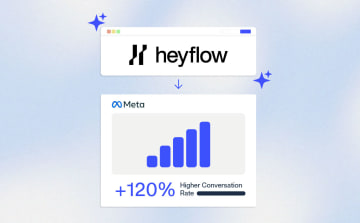
How to Increase Your Meta Ads CVR With the Heyflow AI Funnel Builder Platform
A flat Meta Ads conversion rate is usually a post-click problem. See three ways to fix your funnel and tracking with Heyflow, from full AI automation to manual control.
Read more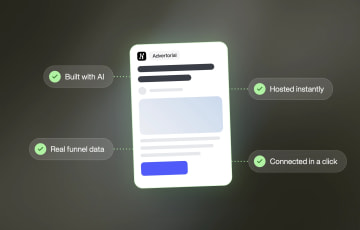
How to Create an Advertorial Landing Page That Sells (With Examples)
Learn how to create an advertorial landing page that sells, with examples by vertical, built by Heyflow’s AI and connected to your funnel in a click.
Read more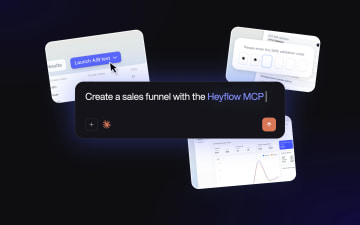
MCP: The Easiest Way to Create a Sales Funnel With AI
Prompt a sales funnel through MCP and it's hosted the moment it's built, connected in a click. That's what makes it the easiest way to build one with AI.
Read more