

Funnel Builders with Built-In A/B Testing







Trusted by 3,000+ marketers






Every day, marketers launch funnels hoping they'll convert, but without A/B testing, you're flying blind. You tweak a headline here, change a button color there, but you never really know what's working. The best funnel builders solve this problem by integrating A/B testing directly into their platforms, letting you test variations, analyze performance, and optimize conversions without juggling multiple tools or drowning in technical complexity.
Key Facts
Built-in A/B testing eliminates tool sprawl and complexity: Native testing within funnel builders removes the need for separate analytics platforms, tracking scripts, or third-party tools, keeping everything in one dashboard and reducing technical errors.
Consistent testing dramatically improves conversion rates: Marketers who regularly A/B test their funnels see conversion improvements of 80–200%, effectively doubling results and cutting cost per lead in half while maximizing ad spend ROI.
Multi-step funnel testing reveals hidden friction points: Unlike single landing page tests, funnel A/B testing evaluates entire user journeys across multiple steps, pinpointing exactly where potential customers drop off and why they abandon the process.
Heyflow offers the most comprehensive testing capabilities: With full funnel path testing, mobile-first optimization, and built-in statistical significance calculators, Heyflow provides deeper testing control than competing platforms.
What Is A/B Testing in Funnel Builders?
A/B testing in funnel builders means comparing two versions of your multi-step funnel to see which drives more conversions. Unlike testing a single landing page, funnel A/B testing evaluates entire user journeys, from the first question through to final submission.
For example, you might test whether asking for an email address first versus a phone number first generates more qualified leads in your lead generation funnel. The winning variation becomes your default, and you can continuously test new ideas to keep improving performance. This data-driven approach removes guesswork and ensures every element of your funnel is optimized based on real user behavior, not assumptions.
Why A/B Testing Matters for Funnels
Single landing pages only tell part of the story. With multi-step funnels, users interact with multiple screens, answer questions, and make decisions at each stage. A/B testing reveals exactly where potential customers drop off and why.
Stop wasting your ad budget: Identify and fix specific steps where users are dropping off, ensuring your ad spend actually leads to sales.
Increase conversion rates: Small improvements at each funnel step compound into dramatic overall conversion lifts, often doubling final submission rates.
Understand user behavior deeply: See which questions engage users, which messaging resonates, and where friction occurs throughout the entire customer journey.
Make data-driven decisions: Replace opinions and hunches with statistically significant test results that prove what drives more conversions.
The risk of not testing: Without testing, you could be losing half your potential customers at the very first step without realizing it. You won't know if your questions are too confusing or if your forms are asking for too much information.
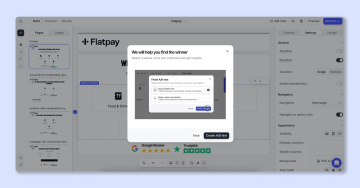
With Heyflow’s no-code testing environment, your marketing team can launch tests and implement winning versions in minutes—no developer required.
Features of Funnel Builders for A/B Testing
To optimize your conversion rates, you need a tool that makes experimentation simple and data-driven. Here are the key features that make A/B testing effective:
Visual variant creator: Drag-and-drop editors let you duplicate funnels and modify elements without coding, making it easy to test different headlines, images, button colors, or entire question sequences quickly.
Smart Traffic Splitting: Automatically divide your visitors between different versions—either 50/50 or custom percentages—to ensure your test results are fair and accurate.
Statistical significance calculators: Built-in tools that automatically determine when your test has collected enough data to declare a winner with 95% confidence, preventing premature decisions based on insufficient sample size.
Logic and Branching Tests: Experiment with "conditional logic" to see if personalized paths based on user answers convert better than standard, linear forms.
Mobile-First Experiments: Since nearly 98% of traffic is mobile, you can create and test specific smartphone versions independently from desktop views.
All-in-One Dashboard: View every metric—from drop-off points to final conversions—in one place without ever having to switch apps.
Seamless tool integrations: Connect test results directly to your CRM, ad platforms, and analytics tools.
Key Metrics for A/B Testing
Tracking the right metrics determines whether your A/B tests actually improve performance or just generate meaningless data. The four metrics below form the foundation of effective funnel testing and help you identify exactly where improvements matter most.
Conversions
The percentage of users who complete your desired action is your primary A/B testing metric. In funnel contexts, conversions typically mean form submissions, qualified leads captured, or purchases completed.
Calculate it by dividing completed conversions by total funnel starts, then multiply by 100. If Variant A converts 8% of users and Variant B converts 12%, you've found a 50% improvement worth implementing immediately.
Bounces
The bounce rate measures users who land on your funnel's first step and leave without any interaction: no clicks, no answers, nothing. High bounce rates (above 60%) signal fundamental problems: your ad targeting is off, your messaging doesn't match user expectations, or your initial design fails to engage. Well-optimized funnels typically see bounce rates below 40%, with top performers under 25%.
Engagement
Engagement metrics reveal how users interact with your funnel before converting. Track time spent on each step, number of questions answered, and progression rate between funnel steps. These metrics help identify which test variant creates better experiences, even if final conversion rates are similar.
Higher engagement often predicts better lead quality and indicates users are genuinely interested rather than rushing through to get something free.
Page Drop-offs
Drop-off rate shows the percentage of users who abandon your funnel at each specific step. This metric is critical for multi-step funnels because it pinpoints exactly where users lose interest or encounter friction.
If 40% of users drop off where you ask for phone numbers, test different approaches: ask that question later, explain why you need it, or add phone validation to improve trust. Reducing drop-offs at high-friction steps can increase overall conversions by 30–50%.
Funnel Builders with Built-In A/B Testing Compared
We analyzed six popular funnel builders with integrated A/B testing to help you choose the right solution for your digital marketing needs.
#1. Heyflow
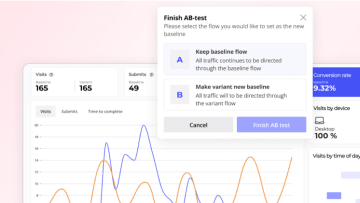
Heyflow delivers the most comprehensive A/B testing suite among funnel builders, enabling complete traffic split customization to control how visitors are distributed across test variants. The platform combines advanced testing capabilities with a no-code interface, making it accessible to marketing teams while offering enterprise-grade features.
Highlights:
Visual decision tree for mapping complex funnel logic
Advanced conditional logic and personalization testing
Custom traffic split to control percentage distribution across variants
Mobile-first optimization across all devices
50+ native integrations with major marketing platforms
Built-in statistical significance calculators
No-code interface for marketing teams
Limitations:
A/B testing features become available starting at the $239/month Scale plan.
Choose Heyflow if you need the most comprehensive testing capabilities with conditional logic and advanced analytics.
#2. ConvertFlow
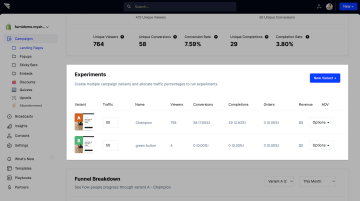
ConvertFlow specializes in on-site conversion elements with strong popup and form testing capabilities. The platform is designed for e-commerce businesses looking to optimize individual conversion touchpoints rather than complete multi-step funnels, offering a visual editor that makes creating test variations straightforward.
Highlights:
Strong popup and form testing capabilities
Visual editor for creating test variations
Traffic splitting between versions
Basic split testing for offers and CTAs
Limitations:
Limited multi-step funnel testing capabilities
Choose ConvertFlow if you're focused on e-commerce and need strong popup and form testing.
#3. Involve.me
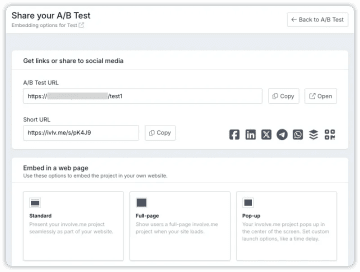
Involve.me excels at interactive content and quiz funnels, with A/B testing capabilities built around their template-based approach. The platform offers an intuitive testing interface that makes it accessible for teams without technical expertise, though customization options are more limited compared to code-free builders.
Highlights:
Template-based testing approach
Traffic distribution controls
Intuitive interface for non-technical users
Basic conversion metrics and analytics
Limitation:
Less flexibility for highly customized funnel designs
Choose Involve.me if if adhering to brand guidelines isn't important/key.
#4. WPFunnels
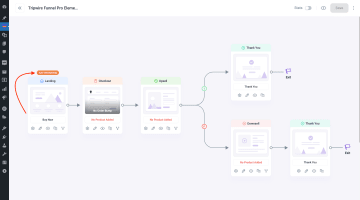
WPFunnels brings WordPress-native A/B testing to e-commerce funnels, with tight WooCommerce integration for testing checkout flows, upsells, and order bumps. The platform lets WordPress users test funnel variations without leaving their familiar environment, making setup straightforward for existing WordPress sites.
Highlights:
WordPress-native testing environment
E-commerce focused with checkout flow testing
Clear analytics dashboard with revenue metrics
Seamless WooCommerce integration for upsells and order bumps
Limitations:
Requires WordPress installation—won't work as standalone
The platform performs well within its niche but lacks the flexibility and advanced features of dedicated funnel builders like Heyflow
Choose WPFunnels if you're already on WordPress and need e-commerce funnel testing.
#5. Unbounce
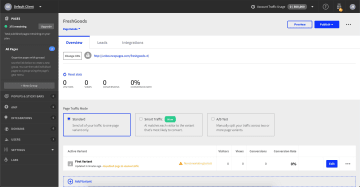
Unbounce has built a strong reputation in landing page testing with robust A/B testing tools and an AI-powered Smart Traffic feature that automatically routes visitors to the best-performing variant. While excellent for single landing pages, the platform's focus means testing entire funnel paths with conditional logic requires complex workarounds.
Highlights:
AI-powered Smart Traffic feature for automatic optimization
Visual editor for straightforward variant creation
Clear performance comparison analytics
Strong reputation in landing page testing
Limitations:
Primarily focused on single landing pages, not multi-step funnels.
Choose Unbounce if you're primarily testing single landing pages for PPC campaigns.
#6. Systeme.io
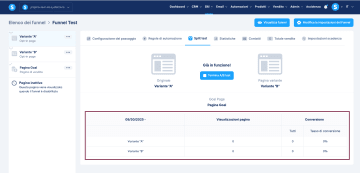
Systeme.io takes an all-in-one platform approach with basic split testing capabilities included even at their entry-level plan. The platform prioritizes breadth of features—including email marketing, course hosting, and automation—over depth in any single area, making it an accessible entry point for budget-conscious businesses just starting with funnel testing.
Highlights:
Simple split testing of funnel pages
All-in-one platform with email marketing and automation
Accessible entry point with free plan available
Basic conversion tracking
Limitations
No advanced features like conditional logic testing or statistical significance calculators
Choose Systeme.io if you're on a tight budget and need basic testing to get started.
Why Heyflow is The Best Funnel Builder with Built-In A/B Testing
Heyflow combines unmatched flexibility with enterprise-grade testing capabilities, all wrapped in a no-code interface that marketing teams can use independently.
What sets Heyflow apart from other funnel builders with built-in A/B testing?
Advanced conditional logic and personalization testing
Mobile-first optimization
Built-in statistical significance calculators
No-code interface—marketing teams can create and launch tests in minutes
AI-powered campaign generation that creates test-ready funnels tailored to your brand
Integration with all major CRM, tracking, and analytics services
These capabilities translate directly to better ROI: when you can test faster, optimize more elements, and make data-driven decisions with confidence, you maximize every dollar spent on ad costs and turn more traffic into qualified leads.
Ready to double your conversion rates with data-driven testing? Start your free Heyflow trial and launch your first A/B test in minutes.
A/B Testing Best Practices
Best A/B testing practices ensure your tests produce statistically significant data that actually improves your funnel's performance and drives more conversions.
Test one element at a time
Changing multiple variables simultaneously makes it impossible to determine which change drove results. Test one variable—like headline, button color, or question order—then move to the next once you have a winner.
Ensure statistical significance before deciding
Wait until your test reaches a 95% confidence level with an adequate sample size before implementing changes.
Run tests long enough to capture user behavior patterns
Most tests need at least 1–2 weeks to account for day-of-week variations and different traffic sources. Stopping tests after just a few days often leads to misleading conclusions based on temporary fluctuations.
Segment your audience for more in-depth insights
Analyze test results by traffic sources, device types, or user demographics to uncover hidden patterns. What works for mobile users might fail on desktop, or paid traffic might respond differently than organic visitors.
Test high-impact elements first
Focus on funnel steps with the highest drop-off rates or elements that directly affect conversion decisions (like CTAs, first questions, or phone validation methods) before optimizing minor details.
Monitor external factors during tests
Be aware of seasonality, major campaigns, or market events that might skew results. A test running during a holiday sale may produce different results than the same test during normal periods.
Implement winners and keep testing
Once you find a winning variation, make it your new control and immediately start testing new ideas against it. Continuous improvement through ongoing testing compounds into dramatic long-term conversion gains.
How to Run A/B Tests Effectively
Running effective A/B tests doesn’t require complex frameworks or endless planning. In practice, the most successful teams rely on a simple, repeatable system that allows them to test continuously and learn fast. Here’s a proven approach based on how high-performing teams run A/B tests across their funnels using Heyflow.
Step 1 – Identify what to test based on data
Use funnel analysis to find drop-off points or low-performing steps. These points highlight the areas with the highest potential impact and help you prioritize tests that affect the most users or offer the biggest conversion lift.
Look at heatmaps, session recordings, or user feedback to identify friction points worth testing. Start with elements that impact the most users or have the biggest potential conversion lift.
Step 2 – Add behavioral insights to understand why users leave
Quantitative data shows where problems occur, but behavioral insights explain why.
Complement funnel analytics with session recordings and heatmaps using tools like Microsoft Clarity. By pairing what you see in Clarity with specific funnel steps in Heyflow, you can uncover friction points and form stronger, evidence-based hypotheses.
Step 3 – Form a clear, specific hypothesis
Every test should start with a specific prediction. For example: “Moving the email field to step two will reduce drop-offs by 15% because users feel less overwhelmed at the start of the funnel.”
A good hypothesis clearly states what you’re changing, why it should work, and which metric you expect to improve.
Step 4 – Create A/B testing in your funnel builder
Use your funnel builder's visual editor to duplicate your funnel and create a variant. Focus on meaningful changes—copy, layout, step order, or form structure—rather than small pixel-level tweaks. Keep everything else identical between variants to isolate the impact of your change.
With Heyflow's visual editor, you can create test variations in minutes without any coding knowledge.
Step 5 – Set up traffic splits and distribution
Configure how visitors will be divided between your control and variant. While 50/50 splits are common, many teams successfully use a 20/80 split to gain early directional insight while minimizing risk. Ensure your testing tool randomly assigns users to prevent bias and maintains consistency if users return during the same session.
Step 6 – Determine test duration and sample size
Let tests run long enough to gather reliable data. As a general guideline, aim for at least 100 conversions per variant before drawing conclusions. Depending on traffic volume, this usually takes one to four weeks. Avoid stopping tests early, even if one variation appears to be winning after just a few days.
Step 7 – Analyze results for statistical significance and validity
Once your test reaches a 95% confidence level with sufficient sample size, review the complete data. Look beyond conversion rates to engagement metrics, drop-off points, and user behavior patterns that explain why one variant performed better.
Step 8 – Roll out the winner and keep testing
Deploy the winning variation across all traffic and document the learnings. Even losing tests provides valuable insights that inform future experiments. Immediately begin planning your next test to continue optimizing funnel steps and driving higher conversions.
Conclusion: Make Your A/B Testing Easy with Heyflow
A/B testing in funnel builders is essential for maximizing conversions and getting the most from every dollar you spend on ads. Without testing, you're making expensive guesses about what works instead of using data to systematically improve your funnel's performance. The right platform transforms testing from a technical challenge into a straightforward process that marketing teams can execute independently.
Heyflow is the most comprehensive solution because it combines custom traffic split capabilities with advanced features like conditional logic testing, visual Decision Tree mapping for funnel logic, and mobile-first optimization—all in a no-code interface. With 50+ native integrations, built-in statistical significance calculators, and the ability to test entire funnel paths rather than just individual elements, Heyflow gives you complete control over your optimization strategy without requiring developer support or juggling multiple tools.
Join 3,000+ marketers who've doubled their conversion rates with Heyflow. Start your free trial today and see why our A/B testing tools are the most powerful on the market—with expert support included every step of the way.
FAQs
What Does A/B Testing Mean?
A/B testing, also called split testing, compares two versions of a marketing asset to determine which performs better. For example, you might test two different headlines on a lead form—showing Version A to half your visitors and Version B to the other half—then measure which generates more conversions to identify the winner.
What Are A/B Testing Tools?
A/B testing tools are software platforms that let you create, run, and analyze split tests without technical expertise. They handle traffic splitting between variants, calculate statistical significance automatically, and track results in real-time dashboards. The best funnel builders have these tools built-in, eliminating the need for separate testing software and simplifying your marketing stack.
What Are The Benefits of Native A/B Testing?
Native A/B testing eliminates the need for separate tools and complex integrations, reducing both costs and technical complexity. Built-in testing provides seamless integration with your funnel data, easier setup for non-technical users, unified analytics in one dashboard, and faster implementation of winning variations—helping you optimize conversions without switching between multiple platforms or managing tracking scripts.
Do I Need Coding Skills for A/B Testing?
No coding skills are required with modern funnel builders like Heyflow. Visual editors and drag-and-drop interfaces make testing accessible to marketers without technical backgrounds. Anyone can create test variants, set up traffic splits, and launch tests in minutes without developer support, giving marketing teams complete independence to optimize funnels quickly.
What is Statistical Significance in A/B Testing?
Statistical significance measures your confidence that test results aren't due to random chance. The standard is 95% confidence level, meaning there's only a 5% probability your results happened by luck. This matters because it prevents making decisions based on random fluctuations rather than real user behavior patterns. Good A/B testing tools like Heyflow calculate statistical significance automatically, telling you exactly when your test has collected enough data to declare a winner reliably.
Which Funnel Builder with Built-in A/B Testing is the Best?
Heyflow is the best choice for comprehensive A/B testing, offering advanced conditional logic testing and mobile-first optimization that other platforms can't match. Trusted by 3,000+ marketers, Heyflow provides the deepest testing capabilities with visual Decision Tree mapping, built-in statistical significance tools, and 50+ native integrations—all in a no-code interface that marketing teams can use independently.
Recommended articles

The Best Google Forms Alternatives in 2026
Looking for a tool similar to Google Forms but with more features and flexibility? Check out our top form builders for your lead generation strategy.
Read more
How to Track Funnel Performance Across Ad Channels
Track funnel performance across multiple ad channels by closing the post-click gap between ad data and conversions. Learn UTM setup, server-side tracking, and per-screen analytics.
Read moreHow to Track Google Ads Conversions From a Lead Funnel
Learn how to track Google Ads conversions from a lead funnel, from GCLID capture and GTM setup to offline conversion import and Enhanced Conversions for Leads.
Read more