
Funnel Platform vs Landing Page Builder for Paid Traffic







Trusted by 3,000+ marketers


For paid lead generation, pick the destination by where qualification happens. A single landing page fits simple offers and warm traffic, a multi-page funnel fits checkout and upsell sequences, and an interactive multi-step form at one URL fits high-value leads from cold, mobile-heavy traffic that sales needs to sort. You don't have to pick one tool for all of them: with Heyflow Pages, the landing page or presell page and the qualifying form run on one platform, with one server-side tracking setup feeding the ad platforms. Whichever you choose, judge it on cost per qualified lead rather than raw conversion rate.
Key Takeaways
Page count is the wrong variable: paid visitors leave at the first ask, at a message mismatch and at every extra page load.
Landing page builders suit many single-offer campaigns; multi-page funnel builders suit transaction sequences with checkout and upsells.
The page and the funnel can run on one platform: Heyflow Pages builds the landing page, presell page or advertorial, and the same server-side tracking reaches six ad platforms from every step.
Lead-gen offers with uneven fit do best when qualification happens inside the destination, one answer at a time, without new page loads.
Score each campaign on offer complexity, lead value, traffic temperature, device mix and attribution needs, then test the winner in your own account.
The click is already paid for. Where should it land?
The destination decides what a paid click buys you, so choose it on qualification and on cost per qualified lead, the number you defend to a VP next quarter. You've set the budget, the bid strategy is live, and Google, Meta or LinkedIn has charged you for the click. Now you decide what sits at the destination URL: a single landing page, a multi-page funnel, or something else.
The definitions are short. A landing page is one page built around one action, with no progression. A multi-page funnel is a series of connected steps (opt-in, sales page, checkout, upsells) that moves a prospect from first click to final sale.
The usual advice on when to use each follows offer type, sales-cycle length and trust needs. A landing page suits single offers, one-time promos and ad campaigns with one clear ask and a shorter sales cycle. A multi-page funnel suits higher-ticket products, longer buying decisions and offers that need trust built first, with CTAs that shift from subscribe to buy to upgrade.
Those criteria hold up. For a paid lead-gen program, though, the funnel vs landing page decision needs one more lens: where qualification happens, and how much you ask of the visitor before their first commitment.
Start with your current destination. Pull its conversion rate and the sales-accepted rate of the leads it produced over the last 30 days. If you can't get the second number, fix that before you change anything else.
Why page count is the wrong variable in funnel vs landing page decisions
Page count is the wrong variable because paid visitors leave at the same kinds of points whether you built one page or five. Whether you pay per click or per impression, you have paid to get the visitor this far, and what happens after the click determines what that spend buys you.
Paid visitors tend to leave at three points, and your own analytics show which one costs you most:
Friction at the first ask, when the visitor sees how much effort the page demands before they've committed to anything.
Intent mismatch, when the page doesn't continue the promise the ad made.
Each additional page load or redirect, which is a fresh chance for a slow render, a back-button tap or a lost tracking parameter.
A long single-page form puts the whole effort in front of the visitor at once. Eight fields on a phone screen tell the visitor "this will take a while" before they've typed a character. A multi-page funnel splits the effort into smaller pieces, but it does that with page loads and redirects. Some of the friction you removed from each step can return as breaks between steps. How much returns depends on load speed, device mix and how cleanly your parameters carry across pages. Measure step-to-step drop-off before you assume the split paid off.
Both architectures share a structural flaw. They decide how much to ask, and when, based on how the pages are laid out rather than on what the visitor has already told you. The better question is where qualification happens: in your sales team's first call, in a form field the visitor skips, or inside the destination itself, one answer at a time.
Progressive disclosure is the UX principle that applies here. You show only what the visitor needs to answer now and reveal the next question after they've answered it. This lowers the effort the visitor perceives at each moment without reducing the total information you collect. It also explains why a funnel's step-by-step pacing can help even when its page loads work against it.
The practical reframe comes down to one question. What is the smallest first ask that still moves this visitor toward a qualified outcome, and can you collect the rest without a new page load? If your current destination asks for contact details before it asks anything about fit, put that order on your test list.
Funnel builder vs landing page builder: what each is built for
Multi-page funnel builders are built for transaction sequences, and landing page builders are built for shipping many focused single-offer pages.
Multi-page funnel builders are designed around sequences: opt-in page, sales page, checkout and upsells, each moving a prospect from first click toward the sale. Funnel CTAs are layered and shift as the prospect moves deeper (subscribe, then buy, then upgrade). Funnels suit higher-ticket products, longer buying decisions and offers that need trust built first. That model fits best when the end of the sequence is a transaction and each step earns the next ask.
A landing page builder is built around single-campaign pages. Its job is to produce a focused page per offer, swap headlines and hero sections quickly, and run variant tests. Landing pages suit single offers, one-time promos and ad campaigns with one clear ask and a shorter sales cycle. That approach works when your team ships many campaigns, each with one clear ask.
For paid lead generation, evaluate any builder in either category against these criteria:
Qualification logic: if the form is a block on the page, find out how you would route a visitor differently based on budget or company size. Ask the vendor whether that requires hidden fields, third-party scripts or post-submit logic in your CRM, or whether the builder handles it natively.
Routing: if the builder routes by page sequence, "if the answer is A, go to page 4" means building and maintaining page 4. Count how many branches your offer needs.
Mobile step UX: check whether tap targets, auto-advance and one-question-per-step layouts are defaults or custom work.
Attribution across steps: every new page is another place where UTMs, click IDs and pixel events have to persist correctly. Test this before launch, not after the first report looks wrong.
The split looks like this. If you sell a product with checkout and upsells, a multi-page funnel builder fits the job. If you run many single-offer campaigns with simple capture, a landing page builder fits.
Many lead-gen offers fall between the two. They involve the longer, trust-dependent decisions that usually point to a funnel, but sales needs fit data before it follows up. For those offers, the deciding factor is where qualification happens and how many page loads stand between the click and the first answer, rather than which category the builder belongs to.
Do you have to choose between a funnel platform and a landing page builder?
Not if the page and the funnel run on one platform. Heyflow Pages builds the landing page, presell page or advertorial, and the quiz or multi-step form behind it runs in the same place. Message match and tracking share one setup instead of two tools: server-side events go to Meta, TikTok, Microsoft, Taboola, Outbrain and OpenAI Ads from the page and the funnel step alike, with Google Ads and LinkedIn tracked client-side. The page is hosted the moment it's built and connected in a click.
That changes the question from which tool to buy to which stages a campaign needs. Warm retargeting may need only the page. Cold native or social traffic may need a presell page, then a few qualifying questions, then the offer. The sections below show where each stage breaks under paid traffic and how to decide which ones to run.
Where each approach breaks under paid traffic
Each approach breaks in a predictable place, and each failure mode has a metric in your own account that exposes it.
Message match across ad sets
A single static page has to serve every angle you test in your ads. Picture a home services company running three Meta ad sets: one on price, one on speed of installation, one on financing. All three point to the same landing page with a generic headline. The visitor who clicked the financing ad sees a hero about quality craftsmanship and has to hunt for the reason they clicked.
The metric that reveals this is conversion rate by ad set or UTM content value on the same destination. If one angle converts far below the others on equal spend, the page may be breaking message match for that segment. Audience quality and creative appeal can produce the same gap, so test a matched variant to confirm. That variant can be a page per angle or a destination whose first question reflects the ad's promise. If the matched version closes the gap, the page was the problem. If it doesn't, look at the audience or the offer.
The mobile fold
A long form on a phone creates perceived effort before any actual effort. The visitor scrolls, sees field after field, and leaves. On desktop, the same form may perform acceptably, which hides the problem inside a blended average.
Segment conversion rate and form-start rate by device. Suppose mobile makes up most of your clicks and mobile form starts trail desktop by a wide margin. Then the layout is a likely suspect, though intent differences, page speed and traffic source mix can also open that gap. Check load time and placement mix first. Then test a mobile-optimized step layout before you change the offer.
Funnel leakage
Each new page in a multi-page funnel is another chance to bounce, and the leaks are partly technical. Cross-domain steps can drop UTM parameters. Redirects can strip click IDs. A pixel can fire on page one and miss page three because a template was cloned without the event. Your ad platform then optimizes toward the wrong signal, or toward almost no signal.
To catch it, compare step-to-step completion inside the funnel. Then reconcile conversion counts across your ad platform, GA4 and your CRM for the same date range. A large gap between platform-reported conversions and CRM records points to broken plumbing rather than weak persuasion.
Junk leads
A low-friction page can post a strong conversion rate while sales rejects much of what it sends. Name, email, submit. The dashboard looks great and the CPL looks great, but the SDR team stops calling those leads within a month.
The metric is cost per sales-accepted lead, or cost per opportunity if your cycle is short enough to measure it. Divide spend by the leads sales actually accepts. If that figure rises while CPL falls, your destination is buying volume and pushing the qualification cost downstream to your sales team.
Run this audit now. For your highest-spend campaign, list which of the four failure modes your data shows. The one with the largest dollar impact on cost per qualified lead is your first test.
Where qualification happens: a multi-step form inside the funnel
An interactive multi-step form compresses a funnel into a single destination URL. The visitor moves through steps the way they would in a funnel, but the steps render in place, with no new page loads and no redirects between them. It keeps the focus of a landing page and the pacing of a funnel, and it can run on its own or sit behind a presell page or advertorial.
The mechanics that make this work on paid traffic:
One or two questions per step, so the visitor never sees the total length of the form.
Tap-friendly answer cards instead of dropdowns and text fields where possible, with auto-advance when a single-select option is chosen.
Conditional branching, which removes questions that don't apply based on earlier answers and routes visitors to different outcomes. A high-intent visitor can go straight to a calendar booking, a lower-intent visitor to a nurture offer, and a disqualified visitor to a polite thank-you that never reaches your sales queue.
Contact details collected after the visitor has answered several low-effort questions, so the first ask is a tap rather than a phone number.
That sequence is a chain of micro-commitments. Each answered card is a small yes, and the visitor has already invested something before the higher-effort ask arrives. The answers are zero-party data in the literal sense: the visitor tells you their budget, timeline or use case directly, and that context travels with the lead.
In Heyflow, the funnel platform for paid traffic, the answers also decide what the ad platforms learn. Conversion events go server-side to six ad platforms, including Meta and TikTok, from whichever step you choose, so a qualified answer can fire the event instead of every submit. Native A/B testing and routing logic sit in the same funnel. Leads can sync to CRMs and marketing platforms such as HubSpot, Salesforce and Klaviyo, send events to GA4, or post to custom webhooks; check the current integration list in Heyflow's documentation against your stack before you plan the migration. Lead data is stored on Heyflow's infrastructure and passed to the systems you connect. Heyflow has EU hosting and is certified for SOC 2 Type II and ISO 27001.
For lead-gen teams, the operational payoff is lead qualification velocity. Qualification happens before the lead exists in your CRM, so routing rules can assign it by fit immediately instead of waiting for an SDR to triage it.
Don't more steps mean more drop-off?
Not necessarily, and the question deserves a test rather than a slogan. The working hypothesis is that abandonment tracks perceived effort more closely than raw step count. A visitor who sees eight fields at once judges the effort before starting, while a visitor who taps one card judges only that card. The leaks you see in multi-page funnels come mostly from page loads, redirects and asking for everything up front, and an in-place multi-step form removes the first two by design.
The hypothesis can still be wrong for your audience. Steps that ask for typed input early, or questions that feel intrusive, will lose people. That's why the step-level drop-off report matters more than the overall completion rate.
If your offer needs at least two qualifying answers before sales should spend time on a lead, and most of your traffic is mobile, put qualification into the form and test it against your current page.
Decision matrix: landing page, multi-page funnel, or multi-step form
Score the offer on paid-traffic variables instead of page count, row by row, and note where it lands.
Variable | Single landing page | Multi-page funnel | Interactive multi-step form | Page plus funnel on one platform |
|---|---|---|---|---|
Attribution and CRM needs | Basic: one conversion event | Event per step, cross-page persistence required | Qualified-lead event plus answer data in CRM fields | One tracking setup: the same server-side events reach the ad platforms from the page and the funnel step |
Offer complexity | Simple, one clear ask (webinar, ebook, free trial with no fit criteria) | Product purchase with checkout and post-purchase offers | Service or B2B offer where fit varies by visitor | Offer that needs a page before the questions: an ecom product sold through an advertorial, a telehealth eligibility check, a lead-gen offer with fit criteria |
Lead value and need to qualify | Low lead value, or every lead is worth contacting | Revenue captured at checkout, so qualification is the purchase itself | High lead value where sales time is the scarce resource | The funnel step qualifies or recommends before the PDP or the sales call |
Traffic temperature | Warm retargeting or brand search that already knows you | Cold traffic for impulse or mid-ticket products | Cold social or broad match traffic that needs sorting | Cold native (Taboola, Outbrain) or social traffic that needs a presell page first |
Device mix | Desktop-heavy B2B traffic | Mixed | Mobile-heavy traffic | Mobile-heavy traffic |
Sales cycle | Short, self-serve | Short to medium, transactional | Medium to long, sales-assisted | Short for ecom, medium to long for sales-assisted lead gen |
Upsells or checkout needed | No | Yes, this is the main reason to choose it | No, or checkout handled downstream | Checkout stays on the PDP; the page and funnel sit in front of it |
Some plain recommendations follow from the table.
A single landing page wins for simple offers, warm retargeting and low-value leads. If a returning visitor already knows your product and just needs a "book demo" button, adding qualification steps adds nothing. If every lead gets the same automated nurture regardless of fit, you don't need routing either.
A checkout funnel wins when the business model depends on the transaction sequence. If your margin comes from order bumps and post-purchase upsells, you need a funnel builder's checkout mechanics.
An interactive multi-step form wins where lead value is high, traffic is cold and sales capacity is limited. Insurance quotes, B2B software demos, home services, financial products and high-ticket coaching all share that profile: plenty of clicks, uneven fit, and an expensive sales conversation at the end.
A page plus funnel on one platform wins when the visitor needs context before the first question. An ecom brand can send native traffic from Taboola or Outbrain to an advertorial, ask a few quick questions, and hand the buyer to the right PDP. A telehealth provider can run cold social traffic to a presell page and then an eligibility form before booking. Heyflow Pages is built for this setup.
Most programs need more than one architecture. A reasonable setup runs retargeting to a short landing page and sends cold prospecting traffic to a qualifying multi-step form.
Score your top three campaigns against this table. Any campaign that lands in the multi-step form column on four or more rows is a candidate for a destination test.
How to choose the best funnel builder or landing page builder for paid traffic
Evaluate builders against your matrix result rather than a feature count, because the best funnel builder for a direct-response product brand can be the wrong tool for a B2B lead-gen team. These are the criteria that affect paid-traffic performance:
Native A/B testing at the destination level, with traffic split inside the tool and results you can break down by device.
Conditional logic that can skip questions, branch to different outcomes, and pass answer values into hidden fields or CRM properties.
Mobile step UX: large tap targets, auto-advance on single-select answers, and layouts that don't push the main action below the fold.
Pixel and GA4 event tracking with control over which event fires at which step, plus support for server-side conversion APIs if your ad platforms rely on them.
CRM and webhook integrations that map answer data to specific fields and handle routing rules, not just a contact record.
Page speed on real mobile connections, measured with your own testing (PageSpeed Insights or field data from your analytics), not vendor claims.
Template depth for your vertical, so the team starts from a working structure instead of a blank canvas.
Data hosting and privacy posture, including where lead data is stored, consent handling, and regional data residency if you take traffic from multiple jurisdictions.
Team workflow for launching a variant per ad set: duplication, shared components, and permissions so a campaign manager can ship without a developer.
Weight the criteria by your matrix result. If you landed in the landing page column, speed and variant workflow carry the most weight. Funnel-column offers should be judged first on checkout, upsell mechanics and cross-step attribution, while multi-step form offers depend on conditional logic, mobile step UX and CRM field mapping.
Verify every compliance and security claim directly with the vendor. Ask for documentation of certifications, the data processing agreement and hosting locations instead of relying on a marketing page. The same goes for integrations: request a demo of the exact sync you need, with your CRM fields.
Before you sign anything, build one real form or page in a trial account, connect it to a test pipeline in your CRM, and fire a test conversion through each ad platform. If any of those steps fails, the tool isn't ready for your paid traffic.
How to test it: a paid-traffic experiment plan
Split one ad set's traffic between your current landing page and a multi-step form, keep everything else identical, and judge the result on cost per qualified lead. The objection that you can't prove the gain is fair, so prove or disprove it in your own account with a design that holds up in front of a VP or client.
Pick one ad set with steady spend and a known lead-quality problem. Split its traffic between your current landing page and a multi-step form, using either your ad platform's experiment feature or the destination tool's built-in A/B split. Keep the ad creative, audience and offer identical so the destination is the only variable.
Set the primary metric before launch: cost per qualified lead, defined as spend divided by leads that sales accepts or that meet your documented qualification criteria. Raw conversion rate becomes a secondary metric. Track these alongside it:
Step-level drop-off in the form, to see which question loses people.
Results by device, since a mobile win can hide inside a flat blended number.
Sales feedback on lead quality, logged in the CRM so it can be counted.
Agreement between platform-reported conversions and CRM records, to confirm tracking parity between variants.
Respect sample size. Calculate the required leads per variant with a standard significance calculator, using your current conversion rate and the smallest improvement worth acting on. Run the test for at least two full weekly cycles so day-of-week patterns even out, and don't stop early because one variant leads after a few days. If your lead volume is too low to reach significance on qualified leads, extend the runtime or test on a higher-volume campaign first.
Agree on the switch threshold in advance. If the form produces a lower cost per qualified lead at comparable volume, with tracking parity confirmed, move that campaign's traffic and test the next one. If it doesn't, you have evidence that your landing page is the right destination for that offer, and that result is worth having too.
Try Heyflow for freeFAQ
What is the difference between a funnel and a landing page?
A landing page is one page built around one action. A funnel is a sequence of connected steps, such as opt-in, sales page, checkout and upsells, that moves a prospect from first click to purchase.
When should I use a landing page instead of a funnel for paid traffic?
Use a landing page for simple offers with one clear ask, warm retargeting traffic and low-value leads where every lead gets the same follow-up. Use a funnel when revenue depends on a checkout and upsell sequence.
Is a funnel builder better than a landing page builder for lead generation?
Neither category wins by default. For lead-gen offers where fit varies, the better choice is the tool that qualifies visitors inside the destination with conditional logic, keeps tracking intact across steps and maps answers into your CRM.
Do more form steps lower conversion rates?
Not necessarily. Abandonment tends to follow perceived effort, so one tappable question per step can hold completion better than a long single page. Check step-level drop-off in your own data before you decide.
Can Heyflow build both the landing page and the funnel?
Yes. Heyflow Pages builds the landing page, presell page or advertorial, and the multi-step form runs on the same platform with one tracking setup.
Recommended articles
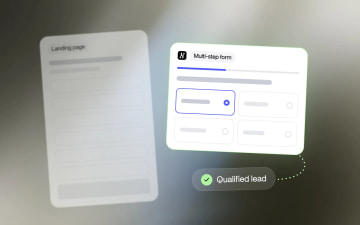
Qualify Leads Before They Submit: Stop Feeding Meta Junk
Cheap leads that sales never closes usually trace back to one setting: every form submit fires the same Lead event. Learn how to ask a few intent questions inside the form, route each answer to its own ending, and send Meta a separate event for the leads worth paying for.
Read more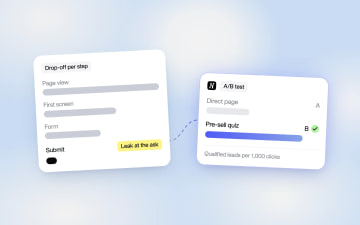
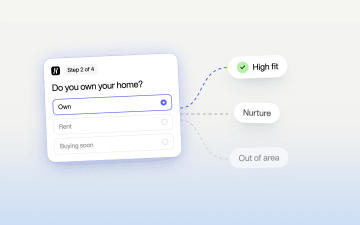
Why Your Landing Page Converts Poorly on Paid Traffic
Your landing page probably isn't broken. Cold paid clicks leave when the page asks for a phone number before the visitor has decided they want anything. Learn how to find the step that leaks, put a presell page or quiz in front of the offer, and prove the fix with an A/B test.
Read more
Heyflow Pricing Explained: Plans, Features and Limits
Heyflow plans start at €19 a month billed yearly and are priced by responses. This guide covers what each plan includes, what counts as a response, what happens at the limit, and a break-even method to check whether a higher plan pays for itself.
Read more