
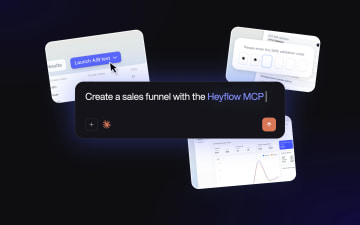
MCP: The Easiest Way to Create a Sales Funnel With AI







Trusted by 3,000+ marketers





The real measure of easy is how little work is left once the AI stops, not how few clicks it takes to start.
Connect an AI tool to Heyflow through MCP, and the AI doesn't just describe a funnel, a quiz, a pre-sell page or an advertorial, it builds one directly inside a platform that already has tracking, validation, and testing built in. Most "easiest way" claims about building something with AI are claims about the first five minutes: how fast can you get a page on screen. That's a reasonable thing to optimize for if the page itself is the finish line. For a sales funnel, it isn't. A funnel with no tracking, no way to validate what comes in, and no way to prove a later change worked isn't finished, no matter how polished it looks on screen. MCP is the mechanism that closes that gap: a funnel built through it arrives connected, not just designed.
Key Takeaways
MCP, the Model Context Protocol, is what makes prompting a sales funnel easy: it lets an AI tool build directly inside Heyflow rather than just describing a funnel you'd still have to wire up yourself.
The easiest way to create a sales funnel with AI comes down to how little manual work is left after the AI is done, not how simple the interface felt at the start.
Three real paths exist: a traditional drag-and-drop builder, prompting a general AI tool with no connection to your infrastructure, and prompting through an AI tool connected via MCP. They are not equally easy once you count what happens after the page is built.
A sales funnel built through Heyflow MCP is hosted the moment it's built and connects to tracking, validation, and native A/B testing in a click, not as follow-up work.
"Just ask AI" produces a page, not proof that a change worked, clean data, or compliance handled by default. That gap doesn't show up on day one; it shows up the first time you need to prove a change worked, or the first time a "lead" turns out to be a bot.
What "Easiest" Means for a Sales Funnel
Ease of use gets measured, by default, at the moment of building: how few clicks, how little setup, how fast to a result on screen. That’s a fair measure for a tool whose output is the whole job. For a sales funnel it only tells half the story. A funnel earns the word “finished” once it can safely accept a real visitor, track what happens to them, validate what comes in and send it where it belongs (phone, SMS OTP and email for lead gen; live product data and add-to-cart for ecom; applications pushed to an ATS for recruiting), and give you a way to know whether the next change you make helps, well after the screen looks right.
Judged by that finish line instead of the first five minutes, "easiest" stops being about interface simplicity and starts being about how much is still left to do once the AI stops generating. A tool that takes ten minutes to produce a fully connected funnel is easier, by that measure, than one that takes ten seconds to produce a page you'll spend the rest of the week wiring up. MCP is what makes the ten-minute version possible: it's the connection that lets an AI tool build inside Heyflow directly, rather than handing back a design with nothing behind it.
Three Paths, Compared
Traditional funnel builder | Prompting a general AI tool | Heyflow MCP | |
|---|---|---|---|
Time to a working draft | Hours to days, manual setup | Minutes | Minutes |
Ad tracking | Manual configuration required | Not included | Server-side to six platforms, native; Google Ads and LinkedIn client-side; set up once per account |
Validation | Often a separate tool or plugin | Not included | Carrier-level phone validation, SMS OTP, email validation |
Proving a change worked | Manual A/B test setup, if available at all | No way to test | Native A/B testing with statistical significance, attached automatically |
Compliance | Assembled piece by piece | Your responsibility entirely | SOC 2, ISO 27001, HIPAA by default |
The first two paths trade speed for completeness in opposite directions: the traditional builder is thorough but slow, the general AI tool is fast but incomplete. The third path is the one where the AI builds inside marketing infrastructure rather than beside it: other MCP-connected builders create forms or single-platform funnels; a funnel prompted into Heyflow arrives with six-platform tracking, validation, testing and routing. If you're comparing MCP-connected builders rather than learning to use one, our comparison of the best funnel builders with MCP integration covers them side by side.
Try Heyflow for freeHow to Create a Sales Funnel With AI, Step by Step
1. Connect your AI tool. Add Heyflow as an MCP connector in Claude, ChatGPT, or Cursor, and sign in to authorize it. This is a one-time step; once connected, it stays connected across future conversations.
2. Describe the funnel. Include the audience, the offer, and the vertical, the same three details that shape any well-built funnel regardless of who or what builds it. A prompt like "build a lead funnel for a roofing company offering free storm damage inspections, targeting homeowners in areas that recently had severe weather" gives the AI enough to work with. So do "build a product quiz for a skincare supplement brand that recommends one of three routines", "write an advertorial for a GLP-1 offer that links to the eligibility quiz", and "build an application funnel for nurses at a regional hospital group". A prompt like "build me a sales funnel" doesn't.
3. Review what comes back. Because the funnel is already live inside Heyflow, built through the MCP connection rather than exported from it, review and edits happen in place rather than requiring an export and rebuild. Read through the question flow the way a visitor would, and flag anything that feels out of order or unnecessary.
4. Refine in the same conversation. Treat the first version as a draft, not a final answer. Asking for specific changes, reordering questions, adjusting the offer language, adding a qualifying question, gets applied directly through the same connection rather than starting over.
5. Ship it. The funnel is hosted the moment it's built, and tracking, validation, and your CRM connect in a click each: enter your pixel and CRM credentials once and every funnel you prompt from then on inherits them. So there's no separate setup phase between "the AI finished" and "the funnel is ready for traffic." This is the step that most clearly separates this path from the other two: beyond that one-time connection, there's nothing left to configure before sending real traffic to it.
Start building with MCPAlready Built It in Claude? Import It.
Not every page starts as a prompt inside Heyflow. There are three ways in: prompt the page directly in Heyflow, import it 1:1 from Claude Design as a ZIP or HTML file, or push it from Claude into Heyflow through the MCP connection. Either way it lands as a Heyflow page, hosted and connected in a click to your funnels, tracking, domain, and analytics, rather than a file that still needs somewhere to live.
This matters most for the formats that sit in front of a funnel: advertorials, listicles, and pre-sell pages that warm up paid traffic and test different angles before the quiz or form. The import is built for Claude Design files and creates a page you can connect to any funnel. Started somewhere else? Describe the page, point Pages at your site for the brand, and it’s rebuilt in minutes.
"Isn't AI-Generated Just Generic?"
A fair objection, and worth answering directly rather than waving off. A funnel generated with no research behind it, no detail on the audience, the offer or their pains, will read generically, because there’s nothing specific for the AI to work from. A thin prompt on its own isn’t the problem: Heyflow’s research agent builds your Brand Hub from your URL, researching your site and the web for your visual identity, audience, pains and proof points, and every funnel you prompt inherits them. Generic output is a research problem, not a ceiling on what the output can be.
Then there’s what the AI has learned from. A model with no connection to real performance data works from general patterns: common question types, standard form and design conventions, best practices scraped from the open web. A funnel prompted through Heyflow MCP draws on patterns across more than 150,000 real funnels and over $2 billion in tracked ad spend, so it starts from structures that have converted in your vertical, not web averages.
What You Can Do With Heyflow MCP
Most performance marketers already have an ad-platform MCP, like Meta Ads, in the same AI tool. Connect Heyflow alongside it and your AI sees ads, spend, and funnels together, and can act on all three. A few things you can type tomorrow:
Build funnels for your winning ads. "Look at my three best-performing Meta ads this month and build a matching pre-sell page and quiz for each, same hook, same offer." The Meta Ads MCP supplies the winners; Heyflow builds the pages and quizzes, with your brand context from Brand Hub.
Build from a brief. "Build a skincare quiz for [brand] that recommends one of our three routines and adds it to the Shopify cart." The quiz ends in add-to-cart, not a contact form.
Import what you built elsewhere. "Push this advertorial into Heyflow and connect it to the GLP-1 quiz." The page arrives in Heyflow and links straight into the funnel behind it.
Find the leak, in the context of spend. "Which screen in the recruiting funnel has the highest drop-off this week, and what's my blended CPL on that campaign?" Heyflow's per-screen analytics and your Meta spend come back in one answer.
Test the fix. "Rewrite the first screen for mobile and set up an A/B test against the current one." The rewrite goes live as a variant with the test already running.
Report across accounts. "Last week's CVR, drop-off, test results and ROAS for all five client funnels, formatted for Slack." Heyflow analytics and your ad-platform data land in one report.
Scaling past one funnel. For an agency running the same offer across ten client verticals, or a company launching a funnel for every product line, two things carry the load. Brand Hub holds a separate brand context for each client, so every funnel prompted for that brand inherits its identity, audience, and proof points. And because anything that speaks MCP can use the connection, including a script, you can build and edit funnels in a loop instead of repeating the same conversation by hand. The underlying infrastructure, tracking, validation, compliance, stays the same regardless of entry point.
Why "Just Ask AI" Isn't the Easiest Path
A general AI tool with no connection to your marketing infrastructure will happily generate a funnel. What it can't do is anything that happens after the page exists, and that gap is where the real work usually hides.
Prompting a general AI tool alone | Heyflow MCP | |
|---|---|---|
Ad signal quality | You wire tracking yourself, manually, platform by platform | Server-side tracking to six platforms, native and maintained |
Submission quality | Every submission is taken at face value, whether it's real or not | Carrier-level phone validation, SMS OTP and email validation built in |
Proving a change worked | Changes ship on faith; whether they worked is left to you to figure out | Every suggested fix ships with a native A/B test: suggestion, test, winner |
Performance insight | Guesses from general best practices, no visibility into your actual data | Real benchmarks and underperformance flags from Heyflow's own analytics |
Compliance | You assemble your own measures, page by page | SOC 2, ISO 27001, HIPAA, and EU hosting by default |
The page itself is the easy part either way. What separates the two paths is everything downstream of it, and that's exactly the part a general-purpose AI tool has no way to handle on its own, since it has no platform to build inside, only text to generate.
What You Don't Have to Set Up Yourself
Specifically, a funnel built through Heyflow MCP arrives with: server-side conversion tracking to Meta, TikTok, Microsoft Ads, Taboola, Outbrain and OpenAI Ads (ChatGPT Ads) (Google Ads and LinkedIn tracked client-side), carrier-level phone validation, SMS OTP and email validation, native A/B testing with statistical significance, per-page drop-off analytics, CRM integrations, consent and cookie management, and compliance coverage including SOC 2, ISO 27001, and HIPAA. It’s hosted the moment it’s built; tracking and CRM need your credentials entered once, and every funnel you prompt from then on inherits them. None of it is a checklist you work through after each funnel exists. It’s part of what “built” means in this context.
Beyond the initial build, the same connection continues to carry weight after the funnel is live. You can ask it directly which questions are causing the most drop-off, and the Optimize Agent proposes the fix and launches the A/B test with it, so a fix arrives with a test attached rather than a hope. On a longer timeline, you can schedule the check-in in your AI tool, a weekly prompt that surfaces the biggest leak and proposes a fix, so improving the funnel doesn't depend on someone remembering to look.
What Happens After the Submit
A submission that's validated but never reaches the next step isn't a finished job, it's a finished form with an unsolved handoff problem behind it.
This is where the gap between the two paths shows up a second time. A funnel generated with no platform connection has no downstream connection at all: every submission needs a manual export, a Zapier workaround, or a developer to wire up a webhook before anyone acts on it. A funnel built through Heyflow MCP inherits native integrations as part of the same connection that built it, so each submission goes where it belongs the moment it's made, tagged with whatever source and campaign data the funnel captured along the way:
A lead routes to HubSpot, Salesforce, or Pipedrive.
A buyer lands in the Shopify cart, with follow-up in Klaviyo.
An applicant goes to Personio, Recruitee, or softgarden.
A reader of a pre-sell page moves on to the funnel or product page it links to.
The practical difference is speed to first contact. A lead sitting in an export file until someone remembers to upload it is a lead going cold while a competitor's sales team is already on the phone. Automatic routing is the difference between a fast funnel and a fast sales cycle.
Where the "Easy" Path Usually Breaks
The version of "easy" that skips infrastructure tends to hold up fine right up until one of a few predictable moments:
The first time you need to explain where a lead came from. Without server-side tracking, attribution back to the specific ad that generated a conversion gets fuzzy fast, and that's usually discovered while trying to justify ad spend, not before.
The first time a batch of leads turns out to be fake. A funnel with no validation layer collects every submission at face value. The cost of that shows up downstream, in a sales team's time spent on contacts that were never real, not at the moment the funnel launched.
The first time someone asks whether a change helped. Without a testing mechanism built in, the honest answer to "did that update improve conversion" is usually a guess. That's a harder conversation after the fact than it would have been to avoid in the first place.
The first time a second person needs to touch the funnel. A funnel built with no platform behind it, just a generated file, lives wherever it was exported to. Handing it to a teammate, a client, or an agency partner means re-explaining what was built and where, rather than simply sharing access to something that already exists in a shared workspace.
None of these show up in a demo. They show up a few weeks into running the funnel, which is exactly why "easiest" needs to be judged by what's still true a month in, not by how the first five minutes felt.
Ready to try this instead of reading about it? Start for free with Heyflow and prompt your first funnel from inside the AI tool you already use.
FAQ
Is this free to start?
Yes, connecting Heyflow MCP and building your first funnel doesn't require a credit card.
Do I need a developer to set this up?
No. The entire process, from connecting the AI tool to prompting the funnel, happens through natural language, with no code involved.
What AI tools does this work with?
Claude, ChatGPT, and Cursor are directly supported, along with any custom agent built to speak the Model Context Protocol.
Is tracking automatic, or do I still need to configure something?
For Meta, TikTok, Microsoft Ads, Taboola, Outbrain and OpenAI Ads (ChatGPT Ads), tracking is server-side and native: enter your pixel and access token once, and every funnel you prompt from then on inherits it. Google Ads and LinkedIn use client-side tracking.
How is this different from starting from a template?
A template is a fixed starting point you still have to adapt. A funnel prompted through Heyflow MCP is generated around the specific audience, offer, and vertical you describe, and is hosted the moment it's built, with tracking and validation connected in a click rather than added afterward.
Can I test different versions of my funnel without adding another tool?
Yes. Native A/B testing with statistical significance is built in, and it's attached automatically to suggested fixes rather than requiring a separate testing tool.
Will the funnel be specific to my business, or generic?
That depends on the prompt more than the tool. A specific audience, offer, and vertical produce a specific funnel. What changes the ceiling on quality is what the AI draws on while generating it: Heyflow's is shaped by patterns across 150,000+ real funnels and $2 billion in tracked ad spend, rather than general web patterns alone.
What if I need to build the same kind of funnel across many clients or verticals?
Brand Hub keeps a separate brand context for each client or brand, so every funnel you prompt for it inherits the right identity and audience. And because anything that speaks MCP can use the connection, including a script, you can build and edit funnels in a loop instead of prompting each one individually in a chat window. Most single-funnel use cases don't need this; it's relevant once the task shifts from building one funnel to building many similar ones repeatedly.
Recommended articles
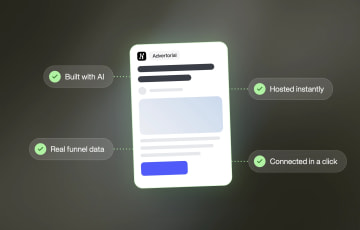
How to Create an Advertorial Landing Page That Sells (With Examples)
Learn how to create an advertorial landing page that sells, with examples by vertical, built by Heyflow’s AI and connected to your funnel in a click.
Read more
Heyflow MCP vs Typeform MCP vs Jotform MCP Compared
A feature-by-feature comparison of Heyflow MCP, Typeform MCP, and Jotform MCP, and which one connects to your ad platforms and CRM.
Read more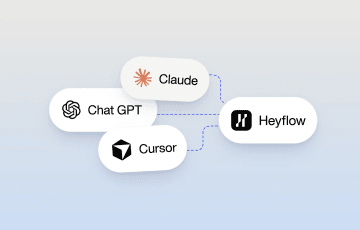
From MCP to Funnel: How to Prompt for Leads With Heyflow
Go from an MCP connection to a live lead funnel: connect Claude, prompt for what you want, and get a funnel that’s hosted the moment it’s built.
Read more