

How to Migrate Your Funnel or Form from ClickFunnels to Heyflow







Trusted by 3,000+ marketers


You have spent months patching ClickFunnels with server-side GTM containers and attribution vendors just to get Meta tracking working properly, and now you are wondering if there is a cleaner way to run paid traffic funnels. There is no direct importer between the two platforms, but that is not the obstacle it sounds like. The actual migration path is faster, and more thorough, than copying pages.
Key takeaways
There is no page importer from ClickFunnels to Heyflow; funnels are rebuilt via AI using the Heyflow MCP Server or Heyflow AI from a prompt or screenshot.
ClickFunnels suits membership, course, and checkout businesses, while Heyflow targets paid-traffic lead generation with server-side tracking for six ad platforms.
Skipping a pre-migration baseline, a three-way reconciliation of ad platform, funnel, and CRM data, makes it impossible to prove uplift or catch tracking regressions.
Heyflow pairs AI-assisted rebuilds with native lead validation, partial submits, and conditional qualification logic to turn a migration into a measurable conversion gain.
Can you import a ClickFunnels funnel into Heyflow?
No. ClickFunnels funnels cannot be imported directly into Heyflow. There is no URL-paste importer, and anyone promising you one for this particular pairing is wrong. The migration route is an AI-assisted rebuild: either connect the Heyflow MCP Server so Claude, ChatGPT, or Cursor analyzes your existing funnel and builds the equivalent inside Heyflow, or generate it directly with Heyflow AI from a text prompt and use Design Import to match your brand from a screenshot or URL.
Before you treat that as a downside, consider what an importer actually gives you. A page-scraping importer produces a pixel-copy of a funnel that was built for a different era of paid traffic, including every conversion problem it already has. It clones the layout and the drop-off. An AI rebuild starts from your offer and your structure and ships a funnel with server-side tracking, lead validation, and conditional logic already wired in.
One disambiguation before you go further: this guide is about moving off ClickFunnels. It is not about the Classic to 2.0 migration inside ClickFunnels, which ClickFunnels documents separately in its own help center.
Should you migrate at all? A 60-second qualifier
ClickFunnels is a sales funnel and checkout platform built for the full journey from opt-in to purchase. It bundles native payments, email follow-up, course hosting, membership areas, and an affiliate center into one subscription. If your business is an info-product launch, a coaching program with a members area, or a course checkout sequence with order bumps and one-click upsells, ClickFunnels covers that stack natively and Heyflow does not. Migrating the whole thing would be a downgrade.
Heyflow is built for teams where funnels drive paid acquisition. The scope is the lead-generation funnel: multi-step qualification, server-side conversion signal, lead validation, screen-level analytics, and A/B testing with statistical significance. Native payments exist via Stripe, Solidgate, credit card, Apple Pay, and Google Pay, with the payment block living inside the flow builder rather than as a third-party embed. PayPal is not offered.
The honest framing is from checkout funnels to lead funnels. Three outcomes:
Your situation | Recommendation |
Paid traffic drives lead-gen funnels; sales or a call center closes | Migrate. This is the core fit. |
Membership, course delivery, or affiliate checkout is the business model | Stay on ClickFunnels for the back end. |
Both: paid acquisition feeds a course or program | Hybrid. Move the acquisition front end to Heyflow, keep the delivery stack where it is. |
Agencies should run this qualifier per client, not per portfolio. A roster of 15 ClickFunnels clients rarely splits cleanly.
What actually changes when you move
Be precise about the delta before you plan the work. ClickFunnels documents a native Meta Pixel plus Conversions API integration, and it documents split testing at the funnel-step level with a confidence score. Anyone telling you ClickFunnels has no server-side tracking and no A/B testing has not opened the docs. The real gaps are breadth, depth, and rigor.
Capability | ClickFunnels | Heyflow |
Server-side conversion tracking | Documented native Meta Pixel + CAPI | Native server-side for six platforms: Meta Conversions API, TikTok Events API, OpenAI Ads, Bing/Microsoft Ads, Taboola, Outbrain. Google Ads and LinkedIn run client-side via pixel. |
Lead validation | None documented | Phone network validation and SMS OTP verification natively, plus email validation and duplicate detection |
Analytics granularity | Funnel and step level, revenue oriented | Per-screen drop-off with device-type filtering, UTM filtering, CVR over time, industry benchmarking |
A/B testing | Page and workflow split tests with a confidence score | Native A/B testing with statistical significance calculation |
Abandonment capture | Not available | Partial submits capture data as users type |
Design control | Template-based with limited flexibility | 2,000+ style variables, 1,000+ Google Fonts, mobile-first, PageSpeed 90+ by default |
Compliance certificates | GDPR DPA, processor role | SOC 2 Type II, ISO 27001, HIPAA with a signed BAA from the Scale plan, GDPR with EU hosting available. TrustedForm and Jornaya/Verisk supported. |
Membership, courses, affiliate center | Native | Not offered |
The asymmetry in the first row is the one that moves money. If Meta is your only channel with a documented server-side path and TikTok, Microsoft Ads, Taboola, and Outbrain run pixel-only, Meta will look like your best channel partly because it is the only one being measured properly. Budget migrates to the best-measured channel instead of the best-performing one, and nobody diagnoses it because the dashboard looks internally consistent.
There is a second, cheaper signal that the gap is real: an entire vendor industry exists to patch ClickFunnels tracking with server-side GTM containers and third-party attribution tools. Specialist agencies productize this as a 7 to 10 day engagement. When the market has priced the workaround, the gap is not theoretical.
Phase 0: baseline before you touch anything
Skip this and your migration becomes politically indefensible. You will have no way to prove the uplift and no way to diagnose a regression.
Capture 14 to 30 days of the following. First, a three-way reconciliation: ad platform reported conversions per channel, funnel platform submissions, and CRM records actually created. The two deltas, platform to funnel and funnel to CRM, separate your signal loss from your integration loss. This single artefact is the most valuable thing you produce in the entire project.
Second, write down your CVR definition. Sessions or unique visitors? Does a partial submit count as a lead? Heyflow's partial submits capture data as users type, which changes both the numerator and the definition of a lead. If you do not fix this definition in writing before cutover, you will report an uplift that is partly a measurement artefact, someone will catch it, and you will lose the room.
Third, export every live URL. Your ClickFunnels pages are sitting inside ad accounts, email sequences, retargeting rules, affiliate links, and sometimes printed QR codes. Every unmapped URL is a leak that runs for months.
Finally, record CPL by channel, mobile versus desktop split, lead-to-contact and lead-to-opportunity rate from sales, and the current monthly cost of your tracking patch layer: sGTM hosting, attribution vendor subscriptions, and specialist hours. For most agencies that last number is larger than the platform license, and it is the financial argument almost nobody makes.
Phase 1: rebuild the funnel
Pick one funnel with meaningful spend, but not your single highest-spend campaign. You want a real read without betting the quarter on it.
Route A: Heyflow MCP with your own AI
The Heyflow MCP Server is a Model Context Protocol connection that lets Claude, ChatGPT, or Cursor build and edit funnels directly inside Heyflow. For a migration, point your assistant at the existing ClickFunnels funnel, have it analyze the structure, copy, question sequence, and branching, then have it generate the equivalent in Heyflow. The funnel ships live with tracking, lead validation, and compliance already wired in.
MCP keeps working after the build. Through the same connection, your AI can query conversion rates, per-screen drop-offs, and benchmark comparisons from Heyflow's analytics, so the assistant that built the funnel can diagnose it a week later. Bring your own AI. Heyflow brings the conversions.
Route B: Heyflow AI
Flow Generation takes a text prompt and returns a performance-ready funnel with tracking and logic intact, not a generic template. Design Import matches your brand from a screenshot or a URL, which is the direct answer to "but my ClickFunnels page is already on brand." Edit on Prompt handles refinement in natural language. Heyflow AI is trained on 150,000+ real funnels and $2B+ in tracked ad spend, and it generates both multi-step flows and standalone pages such as landing pages and advertorials.
MCP and Heyflow AI are complementary, not alternatives. Most teams use MCP for analysis and iteration and Heyflow AI for generation.
Route C: manual build
Use the Heyflow funnel builder directly when you want maximum design control. 2,000+ style variables and 1,000+ Google Fonts cover brand fidelity, the output is mobile-first with PageSpeed 90+ by default, and you embed as a web component rather than an iframe, on a custom domain with SSL.
Whichever route you take, resist the urge to clone screen for screen. A ClickFunnels long-form sales page and a multi-step lead funnel have different optimal structures. Rebuild the intent and the offer, redesign the structure. If you are unsure what good looks like, our guide to funnel design covers the structural decisions that matter most on paid traffic.
Phase 2: rewire the tracking
This is the section nobody else writes, and it is where the ROI case lives.
Heyflow sends events server-side to exactly six platforms: Meta Conversions API, TikTok Events API, OpenAI Ads, Bing/Microsoft Ads, Taboola, and Outbrain. Google Ads and LinkedIn tracking runs client-side via pixel. Say that precisely in your internal documentation, because vague claims cause bad decisions six weeks later when someone assumes Google Ads is getting server-side events.
The sequence: verify your domain, install the pixels, configure the server-side connections per platform, map your events to the funnel steps that matter, confirm deduplication via matching event IDs so the browser event and the server event are not counted twice, then validate Event Match Quality in Meta Events Manager before you move budget.
Deduplication deserves a paragraph on its own because it is the most common quiet failure. If your platform-reported conversions exceed CRM records by more than roughly 10 to 15 percent, suspect double counting before you suspect anything else. Inflated conversions produce inflated ROAS, which produces budget scaled against phantom performance, which is usually discovered only when finance reconciles against closed revenue.
On magnitude, be disciplined. Meta's own Conversions API documentation states the purpose plainly: connecting server, website, app, or CRM data to Meta's systems to optimize ad targeting, decrease cost per result, and measure outcomes. The mechanism is documented by the platform. The magnitude is account-specific and has to be measured in your own parallel run, which is the next phase.
Deploy TrustedForm or Jornaya/Verisk at this stage if your vertical requires consent certification. Certificates are issued per session by the page hosting the script, so certificates generated on ClickFunnels pages do not transfer to Heyflow-hosted sessions. In insurance, solar, and home services, where buyers condition payment on certificate validity, the implementation has to be live and verified before traffic moves, not after.
Phase 3: reconnect integrations and data
Historical leads stay exportable from ClickFunnels, and they belong in your CRM anyway. What you are rebuilding is the pipe, not the archive.
Heyflow has 50+ native integrations including HubSpot, Salesforce, Pipedrive, Zoho, HighLevel, ActiveCampaign, Google Sheets, Airtable, and Monday.com, plus Zapier for 3,000+ apps, Make, webhooks, and a public API. The practical work is field mapping: every field that existed in the ClickFunnels submission needs a destination, and hidden fields carrying UTMs, click IDs, and consent timestamps are the ones teams forget.
While you are in there, shorten the chain. Every Zapier hop between submit and CRM adds latency and a failure point, and in insurance, solar, and real estate, speed-to-lead is a dominant determinant of contact rate. Heyflow's native integrations and automation let you push directly where a Zap used to sit.
Phase 4: go live without breaking campaigns
Do not cut over. Run in parallel.
Keep the ClickFunnels funnel live. Create a second ad set inside the same campaign with the same creative, same audience, and the same budget logic, pointed at the Heyflow funnel. Split paid traffic roughly 20/80 new to old. Hold it until you have a defensible sample, not until the chart looks good on day three.
Compare on per-screen drop-off, not just CPL. The drop-off analytics in Heyflow will tell you exactly which screen the new funnel beats and which it loses, which is the information you need to iterate. CPL alone tells you the result without the reason.
When you shift budget, do three things in the same window. Apply the full 301 redirect map you built in Phase 0, so every legacy URL lands on the right Heyflow screen. Rebuild your retargeting audiences, because Website Custom Audiences built on ClickFunnels URL rules or pixel events stop populating at cutover and need time to re-warm. And accept a short learning-phase volatility window on conversion campaigns, since a new domain and new event configuration restarts optimization. Teams who cut over on their highest-spend campaign and then blame the new platform for two weeks of noise are usually looking at learning phase, not the funnel.
Keep the old funnel reachable but unlinked for 30 days as a rollback path.
Phase 5: make the funnel better, not just different
A one-to-one rebuild captures the tracking gain and leaves the conversion gain on the table. This phase is where the 24% average conversion increase comes from, and where the core promise of doubling the conversion rate, at least an 80% increase, for example 3% to 6%, becomes achievable. After the migration the funnel is not the same, it is better.
Read the drop-off data first. Filter per screen by device type and by UTM. The worst screen is almost never where the team guessed, and the mobile-only drop-off is usually worse than the blended number suggests. Paid traffic is majority mobile, so a screen that performs fine on desktop and badly on mobile is costing you more than the aggregate implies.
Then test, but only if you have the traffic. This is where most teams deceive themselves. At a typical lead-funnel conversion rate in the 7 to 8 percent range, detecting a 15 percent relative lift at 95 percent confidence with 80 percent power requires roughly 9,000 to 11,000 visitors per variant. A funnel seeing 4,000 monthly sessions needs about five months for one conclusive test at a 50/50 split. If that is your situation, you should not be A/B testing button colors. You should be making large structural changes guided by drop-off data and reserving formal significance testing for your high-traffic funnels. Heyflow's native A/B testing calculates statistical significance so you know which bucket you are in rather than guessing.
A related warning: if you are bringing "proven winners" from ClickFunnels split tests into the new build, re-validate them. ClickFunnels' own documentation notes that the confidence score can start below 50 percent when a split test is added to a funnel that already had traffic, so inherited winners from pre-trafficked funnels deserve scrutiny rather than inheritance.
Turn on partial submits to capture data from sessions that abandon mid-funnel. On a funnel with 10,000 monthly sessions at 6 percent completion, if 22 percent of sessions reach screen three and abandon, that is 2,200 sessions carrying partial data. Recovering even 5 to 12 percent of those through follow-up adds meaningful volume to traffic you already paid for. Measure your own recovery rate rather than assuming ours.
Add phone network validation and SMS OTP where lead quality is the binding constraint. The direct effect is obvious: fewer junk numbers reaching your sales team. The compounding effect matters more. Every fake number you accept is also sent to Meta as a positive conversion signal, which teaches the bidding model to find more people who submit fake numbers. Cleaning the signal improves month three more than it improves month one. On a €40,000 monthly spend producing 800 leads, cutting an 18 percent invalid rate to 4 percent raises contactable leads from 656 to 768 and drops effective cost per contactable lead from roughly €61 to €52, with zero change in media spend. Those figures are illustrative; measure your own invalid rate before you model it.
Use conditional logic to qualify, not just to branch. AND/OR rules, a visual logic map, variables, and real-time calculations let you score leads, build ROI or savings calculators, and route by qualification inside the flow. If you are running multi-step funnels, this is where qualification stops being a sales problem and becomes a funnel feature.
Pre-empt the "my CPL went up" conversation
Adding qualification questions such as budget or timeline typically raises CPL while improving the lead-to-customer rate. That is the expected and desirable outcome of a multi-step qualification funnel, not a failure. Agree before cutover that the metric of record is cost per qualified lead, not cost per lead, and that sales reports lead-to-contact and lead-to-opportunity rates alongside marketing's volume numbers. If you skip this conversation, your most successful month will look like your worst one on the dashboard everyone actually opens.
Then re-run the three-way reconciliation from Phase 0 and compare against baseline. That is your proof.
Migrating multiple client funnels as an agency
The per-client economics are the whole argument. If you are currently maintaining a server-side GTM container plus an attribution vendor subscription plus specialist hours per client, model it honestly: setup hours multiplied by your rate, plus twelve months of vendor cost, plus twelve months of maintenance hours. Multiply by client count. For most agencies running more than a handful of performance clients, that annual patch-layer cost exceeds the platform license by a wide margin.
Sequence the rollout rather than attempting it in one sprint. Start with the client whose funnel structure is most representative of your book, build it via MCP, and keep the prompt. The second build is substantially faster than the first because you are reusing an analysis pattern, not just a template. Our guide to automating and scaling lead generation at an agency covers the operational side in more depth, and the Heyflow agency setup handles multi-client management.
Compliance after the move
Heyflow is SOC 2 Type II certified and ISO 27001 certified, supports HIPAA with a signed BAA from the Scale plan with no Enterprise contract required, and supports GDPR with EU hosting available. TrustedForm and Jornaya/Verisk are supported for TCPA consent certification.
For DACH buyers in insurance, finance, and healthcare, the EU hosting option plus an AVV and ISO 27001 is frequently a hard procurement gate rather than a preference, and it is often the actual migration trigger ahead of CPL. ClickFunnels, for its part, publishes a DPA and positions itself as a data processor with the customer as controller, and states openly in its own GDPR guidance that it sells software rather than a done-for-you compliance package. Both statements are fair. Which one satisfies your DPO is a question for your DPO.
For US healthcare lead gen, the BAA availability from the Scale plan is the operative detail. Verify the plan requirement rather than assuming it is on every tier, because it is not.
FAQ
Is there any way to import my ClickFunnels pages into Heyflow automatically?
Not as a direct page import. The closest equivalent is Design Import inside Heyflow AI, which matches your brand from a screenshot or a URL so the rebuilt funnel looks like your existing pages without manual style work. The structure and logic come from either a Heyflow AI text prompt or from your own AI assistant via the Heyflow MCP Server, which can analyze the existing funnel and build the equivalent.
Will migrating reset my Meta pixel or push my campaigns back into learning?
Your pixel and its historical data stay with your Meta ad account, so nothing is deleted. However, a new domain and a new event configuration will typically restart the learning phase for conversion campaigns, so expect short-term volatility. This is why you run the Heyflow funnel as a parallel ad set first and shift budget on evidence rather than cutting over on your highest-spend campaign.
What happens to my existing ClickFunnels URLs that are live in ads and emails?
Export every live URL before you build anything and create a complete 301 redirect map to the matching Heyflow screens. Your legacy URLs sit in ad accounts, email sequences, retargeting rules, affiliate links, and sometimes printed material, and any URL you miss leaks traffic quietly for months. Treat unmapped URLs as a blocking item before cutover, not a cleanup task after it.
Can Heyflow handle payments, or do I need to keep ClickFunnels for checkout?
Heyflow supports native payments via Stripe, Solidgate, credit card, Apple Pay, and Google Pay, with the payment block built into the flow rather than embedded from a third party. PayPal is not offered. If your business depends on course hosting, membership areas, or an affiliate center, ClickFunnels covers that natively and the sensible setup is a hybrid: Heyflow for the paid acquisition funnel, ClickFunnels for delivery and checkout.
Does Heyflow send server-side events to Google Ads and LinkedIn?
No. Google Ads and LinkedIn tracking in Heyflow is client-side via pixel. Native server-side tracking covers six platforms: Meta Conversions API, TikTok Events API, OpenAI Ads, Bing/Microsoft Ads, Taboola, and Outbrain. Document this distinction internally so nobody builds a measurement plan on an assumption that does not hold.
How do I prove the migration worked?
Capture a three-way reconciliation before you start: ad platform conversions, funnel submissions, and CRM records created, over 14 to 30 days. Define your CVR denominator in writing, including whether partial submits count as leads, so the before and after are measured identically. Then run the parallel ad set until you have a defensible sample and compare per-screen drop-off alongside cost per qualified lead, not cost per lead alone.
Recommended articles
The 5 Best AI Quiz Funnel Builders for Mortgage Lead Generation
Compare the 5 best AI quiz funnel builders for mortgage lead generation: AI features, lead qualification, tracking, compliance, and pricing.
Read more
Best AI Quiz Funnel Builders for CRM Software
Static demo forms can't qualify leads. Compare the 4 best AI quiz funnel builders for CRM software on AI depth, integrations, and pricing.
Read more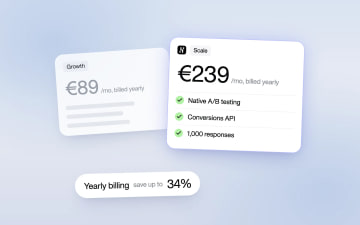
Heyflow Pricing Explained: Plans, Features and Limits
Heyflow plans start at €19 a month billed yearly and are priced by responses. This guide covers what each plan includes, what counts as a response, what happens at the limit, and a break-even method to check whether a higher plan pays for itself.
Read more