
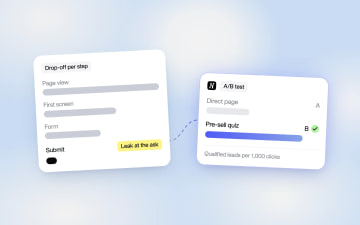
Why Your Landing Page Converts Poorly on Paid Traffic







Trusted by 3,000+ marketers


A landing page converts poorly on paid traffic when a cold click from Meta or TikTok lands on a static page that asks for a form or a card before the visitor has decided they want anything. The fix is to find the step where people leave, put a presell page or quiz between the ad and the offer, and prove the change with a native A/B test judged on qualified leads per 1,000 clicks.
Key Takeaways
Published average landing page conversion rate benchmarks vary widely, because each source measures different pages, traffic sources and actions, so a blended number cannot tell you why yours is low.
On paid traffic, conversion rate is a property of the whole journey from ad click to offer, and a cold prospecting click behaves differently from a brand-search click on the same page.
Cold traffic needs a presell page or quiz between the ad and the offer, so the visitor qualifies themselves before you ask for a phone number or a credit card.
Measure drop-off per step, because one page-level rate hides whether people leave at the headline, at the first question, or at the ask.
Change one thing at a time and run it against the current page with native A/B testing until the winner is proven.
Why paid traffic changes the landing page conversion math
On paid traffic, the useful version of a conversion rate is per traffic source and per step, not one blended rate for the page. The formula itself is simple: desired actions divided by opportunities, times 100. What matters is which actions and which visitors you put into it.
Your landing page converts at 1.5 to 2% on cold prospecting traffic, every benchmark article you have read quotes a different average and none of them explain yours, and the next spend review is in two weeks. Nothing on the page looks broken. The cause sits in the journey, and a landing page conversion rate measured as one blended number hides exactly where the visitor's decision fails. The mechanism is the same whether you sell solar leads or telehealth consults.
That is also why published averages don't help with a paid-traffic problem. The less a page asks for, the more visitors say yes, so a webinar opt-in and a quote form never belong in the same benchmark.
Those benchmarks disagree because they measure different things. A blended median mixes organic, email, referral and paid clicks on the same page. A paid-search benchmark covers warm, intent-driven traffic that typed a query before it clicked. A webinar opt-in asks for an email, while a quote form asks for a phone number and a conversation. None of them measured a cold Meta or TikTok prospecting click landing on a form. Comparing your 1.8% against someone else's 6% tells you nothing until you know their source and their action. You need your own numbers, per step, per traffic source.
Before you start: what you need in place
Set up four things before you change anything, because fixing a page without per-step data means testing blind. First, tracking that reports a conversion for every step a visitor completes (page view, first answer, last answer, submit, qualified lead) and sends the final event back to the ad platform, server-side where the platform supports it, with field mapping so the match quality holds. Second, a clean split of traffic by source and temperature: cold prospecting, retargeting and brand search each get their own utm_source and utm_campaign values and ideally their own page. Third, a baseline conversion rate per page over at least a few hundred clicks per source, because a 2% rate from 60 clicks is noise. Fourth, agreement on what a conversion is. A raw lead, a qualified lead and a purchase are different numbers, and a spend review that mixes them will not end well.
The landing page conversion rate formula works at every step, so compute it per step: visitors who saw step two divided by visitors who saw step one, and so on down the funnel. That per-step series is the diagnostic tool. The page-level number is the summary.
How to fix a landing page that does not convert on paid traffic
Move the ask later, after the visitor has told you something, and prove it with a split. A cold click from Meta, TikTok, display or native placements on Taboola and Outbrain has shown mild curiosity, and a static page often responds by asking for a phone number on the first screen. If your per-step drop-off shows the leak at the ask rather than at the first screen, commitment is being requested before interest is earned.
Find the step that leaks before you touch the page
Read your per-step drop-off for cold traffic only. If 70% of visitors who reach the form leave without submitting, the problem is the ask, and no headline rewrite will fix it. If 60% bounce before scrolling, the problem is the match between the ad and the first screen. Write the leak down as a sentence: "Cold Meta clicks reach the form at 48% and submit at 9%." That sentence tells you what to change. A blended 2% does not.
Match the page to the click's temperature
A prospecting ad on Meta or TikTok should land on a presell page: an advertorial, a listicle, a quiz or a short story page that warms the visitor before the offer. A brand-search click on Google can go straight to the form, because that person already knows you. Run the same page for both and the cold click drags the number down. Build one presell variant per cold angle, keep the direct page for warm sources, and never report them as one rate. The same applies in ecommerce, because cold clicks don't buy on a PDP, and on native, where a reader who clicks from an article on Taboola or Outbrain expects to keep reading, so an advertorial fits that click better than a form. Heyflow Pages builds the presell page, advertorial or listicle in the same place as the funnel behind it, so the page and the conversion step share one tracking setup. Start from a prompt, or import a page designed in Claude Design and edit it the moment it lands; it's hosted the moment it's built, connected in a click.
Move the ask later with a quiz step
Put one question per step before any field asks for contact details, and make the questions ones the visitor wants to answer: "Do you own your home?" or "What is your monthly electric bill?" Each answer is a micro-commitment that also qualifies the lead. Phone and email come after the visitor has invested four or five taps. The objection that every step loses people is true, and it is also the point: the losses now show up at a step you can see.
Measure drop-off per step and send the right event back
Instrument every step as its own conversion so you get a series, not a summary. Then choose the event you want the ad platform to optimize toward. "Quiz started" and "qualified lead" describe different people, and whichever one you send is the outcome the platform will treat as success. Send it server-side and map the fields (phone, email, zip) so the platform can match the conversion to the click. Optimize toward the deepest event that still fires often enough to give the platform volume, and check that choice with a test rather than assuming it.
Run the presell variant against the direct page with native A/B testing
Split cold traffic 50/50 between the current page and the presell funnel, hold the ad creative and audience constant, and read qualified leads per 1,000 clicks rather than form-step rate. Let the test run until it reaches statistical significance and covers full weekly cycles. Then ship the winner and start the next test.
Put together, the process looks like this. A telehealth operator sees cold Meta clicks reach the intake form at 50% and submit at 8%, for a page-level landing page conversion rate of 4% that the spend review calls "below benchmark". The operator builds a four-question symptom quiz in front of the same intake, runs it 50/50 against the direct page, optimizes both toward a server-side "qualified intake" event, and after two weeks compares qualified leads per 1,000 clicks. Whichever wins gets the budget. The number that was argued about in the review is replaced by one that was proven.
A full example, start to finish: solar leads from Meta
Picture a solar lead-gen operator spending $60,000 a month on Meta prospecting in Texas and Arizona. The landing page is short: a headline about cutting the electric bill, two bullet points, a form with name, phone, email, zip, and a "Get my quote" button. Cold traffic converts at 1.8%. Benchmark roundups quote far higher averages for lead generation, so the review keeps asking what is wrong with the page.
Step one is instrumenting the page so each scroll depth and the form itself fire as separate events, split by utm_source. Two weeks of data show that 62% of cold visitors scroll to the form and 3% of those who see it submit. The copy is doing its job. The ask is the leak.
Step two is building the presell funnel. The new entry point is a quiz: "See if your roof qualifies for the 2026 incentive." The first question asks "Do you own your home?", the second asks for the monthly electric bill in ranges, and the third asks about roof shade. The fourth asks for the zip code, which also lets the funnel route renters and low-bill households to a polite exit instead of the sales team. Only after the fourth question does the funnel ask for name and phone, with carrier-level phone validation so fake numbers never reach the dialer. The operator also sets up partial submits, so a visitor who answered three questions and left still lands in the CRM as a partial lead with those answers attached, and sales can decide whether that lead is worth a call.
Step three is choosing the event and setting up the test. The operator sends a server-side "qualified lead" event that fires only for homeowners who pass phone validation, with phone, email and zip mapped so Meta can match the conversion to the click. Cold traffic is split 50/50 between the old page and the quiz funnel with native A/B testing, while the creative and the audience stay the same, and the test runs through full weekly cycles.
Step four is reading the result in the right unit. The quiz funnel loses some visitors at every step, so its first-step rate will look worse than the old page's scroll rate, and that is expected. The comparison that matters is qualified leads per 1,000 clicks and cost per qualified lead from the CRM. If the quiz wins, it takes the budget and the next test starts on its weakest step. If it loses, the per-step data shows which step to fix before the rerun, which is more than the old 1.8% could ever tell the review.
Second example: a DTC skincare quiz on TikTok
A presell quiz in front of the product page gives cold TikTok visitors a reason to buy. A DTC skincare brand sends TikTok prospecting traffic straight to a product detail page (PDP), and cold clicks don't buy on a PDP: the visitor watched a short video, has no idea which product fits their skin, and the page asks them to choose a variant and add it to the cart. The per-step data shows most visitors leave between the PDP view and add to cart, long before checkout.
The brand builds a skin quiz that asks about skin type, main concern, current routine and sensitivity, then recommends one product or a bundle and links to that PDP. The visitor arrives with a reason to buy, and the brand keeps the answers as zero-party data for follow-up emails. If the quiz asks for an email before it shows the recommendation, that ask becomes a step of its own, with its own drop-off you can read.
The test follows the solar pattern. Half of the cold TikTok traffic goes to the PDP as before and half goes to the quiz, the quiz completion goes back to TikTok as a server-side event, and the brand reads purchases per 1,000 clicks from its store data for each variant. Add-to-cart rate explains the result, and purchases decide it.
What comes with Heyflow
Everything in this playbook can run in one place, from the presell page to the event the ad platform optimizes toward.
Heyflow Pages builds the presell page, advertorial or listicle in the same place as the funnel behind it, so the page and the conversion step share one tracking setup.
Server-side conversion events with field mapping, so the platform can match a qualified lead to the click. That covers the native networks Taboola and Outbrain as well as the social platforms.
Native A/B testing for funnel variants, so the presell funnel and the direct page can be split without a separate testing tool.
Carrier-level phone validation and partial submits for lead gen funnels, so fake numbers stay out of the dialer and half-finished quizzes still reach the CRM.
How to measure conversion rate per step
List the steps in the order a visitor meets them, apply the conversion rate formula to each pair, and the lowest rate in the series is your leak. The steps are ad click, page view, first answer, each later answer, contact details, submit and qualified lead; step two's rate is the visitors who reached step two divided by the visitors who reached step one.
Run that series separately for each traffic source and temperature, using the utm_source and utm_campaign values you set up earlier. Mix in brand search and a presell funnel that works for cold Meta traffic can look average. Tie the last step to the CRM.
Two numbers summarize the series for the people who don't read it: qualified leads per 1,000 clicks and cost per qualified lead. Both stay comparable across a direct page and a funnel with more steps, which a page-level conversion rate does not.
How load speed affects conversion on paid traffic
You pay for the click before the page has loaded, so every visitor who leaves during a slow load is spend with no chance to convert. Paid social clicks often open inside the app's built-in browser on a cellular connection, which makes a slow first screen worse. Check the URL in Google PageSpeed Insights and read the mobile field data, then test the page inside the apps you buy traffic from.
Load speed also shows up in the per-step series. If a large share of paid clicks never registers a page view, look at load time before you touch the copy.
How to iterate without resetting what you learned
Change one thing per test and keep the winner as the new control. If you rewrite the headline, reorder the quiz and change the offer at once, a win tells you nothing about which change caused it, and a loss sends you back to the start.
Work down the per-step series from the biggest leak. Once the ask is fixed, the next weakest step is often the first screen of the presell page, so the next test is the angle or the first question. Keep the creative and audience fixed while a test runs, because any change there resets the conditions you are measuring.
Keep a short test log with the hypothesis, the leak sentence it was based on, the run time and the result. A losing test still tells you something, and the log stops the team from rerunning ideas that already failed.
How to report the result in a spend review
Lead with the leak sentence from your diagnosis, for example "Cold Meta clicks reach the form at 62% and submit at 3%", because it explains the old number in one line. Then show the test: what changed, how long it ran, and qualified leads per 1,000 clicks and cost per qualified lead for each variant.
Report cold prospecting, retargeting and brand search as separate rows. A blended rate invites the benchmark argument you are trying to end, while a per-source table shows where the budget works and where it still leaks. Close with the next test and the step it targets, so the review agrees on the plan along with the result.
Where benchmarks fit
Benchmarks are a sanity check, and they only work when the source and the action match yours. Paid-search benchmarks describe warm search traffic, and webinar opt-in rates describe a small ask, so neither says much about a cold Meta click landing on a quote form.
Use a benchmark to decide whether a number deserves a closer look, then use your own per-step series to decide what to do about it. Your own history for the same source and the same action is the better yardstick.
Examples by vertical
Vertical | Presell step | Event sent back |
|---|---|---|
Solar and home services | Short eligibility quiz on home ownership, bill size, roof shade and zip code before contact details | Qualified lead, not quiz start |
Insurance and financial services | Advertorial that explains the product in plain language, then a quiz that sorts visitors by need before the phone number | Qualified lead |
Telehealth | Symptom quiz in front of the intake form, so the intake opens only for visitors the service can treat | Qualified intake |
DTC ecommerce | Product-finder quiz or listicle between the ad and the PDP | Purchase, judged per 1,000 clicks |
Native traffic on Taboola and Outbrain | Advertorial or listicle as the first step, because readers arrive from an article | Deepest event with enough volume |
Common issues
Why does my landing page test never reach significance?
Paid budgets limit traffic. Run the test on your highest-volume cold campaign, measure at a step that fires often enough, and let it run through full weekly cycles before you call it.
Why did leads go up while lead quality went down?
A shorter or easier path can raise submissions and lower the share sales accepts. Judge every test on qualified leads, and keep the qualifying questions in the quiz.
Why is the ad platform optimizing toward the wrong people?
If you send "quiz started" as the conversion, the platform will find people who start quizzes. Send the deepest event that still fires often enough to give the platform volume.
Why do the presell page and the funnel report different numbers?
When the page and the funnel run in separate tools with separate tracking, the steps between them don't reconcile. Building both in one place with one tracking setup removes that gap.
Why does the page work on desktop and fail on mobile?
Check load time and the layout inside in-app browsers, and keep one question per step so the keyboard never hides the next action.
Try Heyflow for freeFAQ
Why do cold Meta clicks convert worse than brand search?
Cold clicks haven't decided they want anything yet, while brand-search visitors already know you. Give cold traffic a presell page or quiz before the ask, and report the two sources as separate rows.
Why is my landing page not converting on paid traffic?
Usually because the page asks for commitment before a cold visitor has decided they want anything. Measure drop-off per step to find where they leave, then fix that step, often by moving the ask behind a presell page or quiz.
Don't extra steps lower the conversion rate?
Each step loses some visitors, and you can see exactly where. A quiz in front of the ask can still produce more qualified leads per 1,000 clicks than a single form, and an A/B test against the current page is how you find out.
Do I need a separate page for each traffic source?
Cold prospecting traffic needs a presell page or quiz, while brand search can go straight to the form. At minimum, keep cold and warm traffic on separate variants and never report them as one rate.
How long should a landing page test run?
Until it reaches statistical significance and covers full weekly cycles, so day-of-week swings don't decide the result.
Recommended articles
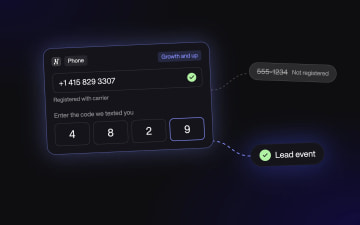
How to Stop Fake Leads From Meta Lead Ads Before Your CRM
Fake leads cost you twice: once when sales dials a dead number, and again when Meta learns to find more people like them. This guide shows how to stop them at the point of capture with phone validation, SMS OTP and qualifying questions, so only verified leads reach your CRM and your ad set.
Read more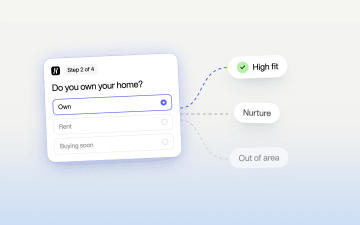
Qualify Leads Before They Submit: Stop Feeding Meta Junk
Cheap leads that sales never closes usually trace back to one setting: every form submit fires the same Lead event. Learn how to ask a few intent questions inside the form, route each answer to its own ending, and send Meta a separate event for the leads worth paying for.
Read more
Funnel Platform vs Landing Page Builder for Paid Traffic
A landing page builder ships focused single pages, a funnel builder runs checkout sequences, and a multi-step form qualifies visitors on one URL. This comparison shows which destination fits your offer and traffic, how to run the page and the funnel on one platform with one tracking setup, and how to test the choice on cost per qualified lead.
Read more